

v6.03.179 SSNP179 – Membrane de Cook en grandes déformations plastiques#
Résumé:
L’objectif de ce test est d’apporter une vérification supplémentaire des modélisations de type incompressible sur le problème de la membrane de Cook qui un problème très souvent utilisé pour tester les méthodes numériques dans la littérature.
Synth_se_des_r_sultats
Solution de référence#
Grandeurs et résultats de référence#
La solution numériquede l’article [1] donne:
Lieu |
Instant |
Composante (DEPL) |
Valeur |
Nœud A en \((48,60)\) |
\(t=1s\) |
DX |
\(-6.23907\mathit{mm}\) |
Nœud A en \((48,60)\) |
\(t=1s\) |
DY |
\(7.00031\mathit{mm}\) |
Incertitudes sur la solution#
La solution provient d’un autre code de calcul sur un maillage très fin.
Référence bibliographique#
[1] Geometrically nonlinear enhanced strain mixed methods and the method of incompatiblemodes , J.C. Simo, F. Armero, Internat. J. Numer. Methods Engrg. 33(7) (1992) 1413-1449
Modélisation A#
Caractéristiques de la modélisation#
On utilise une modélisation D_PLAN_INCO_UPG.
Caractéristiques du maillage#
Le maillage est constitué de mailles de type QUAD8 (quadrangle quadratique), avec un total de 256 éléments.
Grandeurs testées et résultats#
On teste les résultats de la modélisation par rapport à la solution numérique de référence présentée en 2 , et également en non-régression.
Lieu |
Instant |
Composante (DEPL) |
VALE_REFE |
Precision |
Nœud A en \((48,60)\) |
\(t=1s\) |
DX |
\(-6.23907\mathit{mm}\) |
2% |
Nœud A en \((48,60)\) |
\(t=1s\) |
DY |
\(7.00031\mathit{mm}\) |
2% |
Identification |
Composante |
Type de référence |
Tolérance |
Nœud A en \((48,60)\) |
DEPL/DX |
NON_REGRESSION |
0.001% |
Nœud A en \((48,60)\) |
DEPL/DY |
NON_REGRESSION |
0.001% |
Nœud A en \((48,60)\) |
SIEQ_ELNO/TRSIG |
NON_REGRESSION |
0.001% |
Nœud C en \((24,30)\) |
DEPL/DX |
NON_REGRESSION |
0.001% |
Nœud C en \((24,30)\) |
DEPL/DY |
NON_REGRESSION |
0.001% |
Nœud C en \((24,30)\) |
SIEQ_ELNO/TRSIG |
NON_REGRESSION |
0.001% |
Modélisation B#
Caractéristiques de la modélisation#
On utilise unemodélisationD_PLAN_INCO_UPG.
Caractéristiques du maillage#
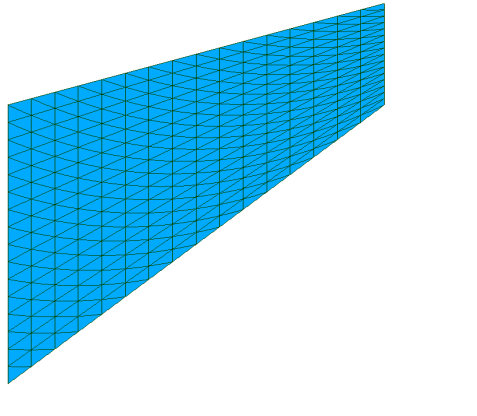
Le maillage est constitué de mailles de type TRIA6 (triangle quadratique), avec un total de 512 éléments.
Grandeurs testées et résultats#
On teste les résultats de la modélisation par rapport à la solution numérique de référence présentée en 2 , et également en non-régression.
Lieu |
Instant |
Composante (DEPL) |
VALE_REFE |
Precision |
Nœud A en \((48,60)\) |
\(t=1s\) |
DX |
\(-6.23907\mathit{mm}\) |
1% |
Nœud A en \((48,60)\) |
\(t=1s\) |
DY |
\(7.00031\mathit{mm}\) |
1% |
Identification |
Composante |
Type de référence |
Tolérance |
Nœud A en \((48,60)\) |
DEPL/DX |
NON_REGRESSION |
0.001% |
Nœud A en \((48,60)\) |
DEPL/DY |
NON_REGRESSION |
0.001% |
Nœud A en \((48,60)\) |
SIEQ_ELNO/TRSIG |
NON_REGRESSION |
0.001% |
Nœud C en \((24,30)\) |
DEPL/DX |
NON_REGRESSION |
0.001% |
Nœud C en \((24,30)\) |
DEPL/DY |
NON_REGRESSION |
0.001% |
Nœud C en \((24,30)\) |
SIEQ_ELNO/TRSIG |
NON_REGRESSION |
0.001% |
Modélisation C#
Caractéristiques de la modélisation#
On utilise une modélisation D_PLAN_HHO_121
Caractéristiques du maillage#
Le maillage est constitué de mailles de type QUAD8 (quadrangle quadratique), avec un total de 256 éléments.
Grandeurs testées et résultats#
On teste les résultats de la modélisation par rapport à la solution numérique de référence présentée en 2 , et également en non-régression.
Lieu |
Instant |
Composante (DEPL) |
VALE_REFE |
Precision |
Nœud A en \((48,60)\) |
\(t=1s\) |
DX |
\(-6.23907\mathit{mm}\) |
2% |
Nœud A en \((48,60)\) |
\(t=1s\) |
DY |
\(7.00031\mathit{mm}\) |
3% |
Identification |
Composante |
Type de référence |
Tolérance |
Nœud A en \((48,60)\) |
DEPL/DX |
NON_REGRESSION |
0.001% |
Nœud A en \((48,60)\) |
DEPL/DY |
NON_REGRESSION |
0.001% |
Nœud A en \((48,60)\) |
SIEQ_ELNO/TRSIG |
NON_REGRESSION |
0.001% |
Nœud C en \((24,30)\) |
DEPL/DX |
NON_REGRESSION |
0.001% |
Nœud C en \((24,30)\) |
DEPL/DY |
NON_REGRESSION |
0.001% |
Nœud C en \((24,30)\) |
SIEQ_ELNO/TRSIG |
NON_REGRESSION |
0.001% |
Modélisation D#
Caractéristiques de la modélisation#
On utilise une modélisation D_PLAN_HHO_121
Caractéristiques du maillage#
Le maillage est constitué de mailles de type TRIA6 (triangle quadratique), avec un total de 512 éléments.
Grandeurs testées et résultats#
On teste les résultats de la modélisation par rapport à la solution numérique de référence présentée en 2 , et également en non-régression.
Lieu |
Instant |
Composante (DEPL) |
VALE_REFE |
Precision |
Nœud A en \((48,60)\) |
\(t=1s\) |
DX |
\(-6.23907\mathit{mm}\) |
2% |
Nœud A en \((48,60)\) |
\(t=1s\) |
DY |
\(7.00031\mathit{mm}\) |
3% |
Identification |
Composante |
Type de référence |
Tolérance |
Nœud A en \((48,60)\) |
DEPL/DX |
NON_REGRESSION |
0.001% |
Nœud A en \((48,60)\) |
DEPL/DY |
NON_REGRESSION |
0.001% |
Nœud A en \((48,60)\) |
SIEQ_ELNO/TRSIG |
NON_REGRESSION |
0.001% |
Nœud C en \((24,30)\) |
DEPL/DX |
NON_REGRESSION |
0.001% |
Nœud C en \((24,30)\) |
DEPL/DY |
NON_REGRESSION |
0.001% |
Nœud C en \((24,30)\) |
SIEQ_ELNO/TRSIG |
NON_REGRESSION |
0.001% |
Modélisation E#
Caractéristiques de la modélisation#
On utilise une modélisation 3D_INCO_UPG
Caractéristiques du maillage#
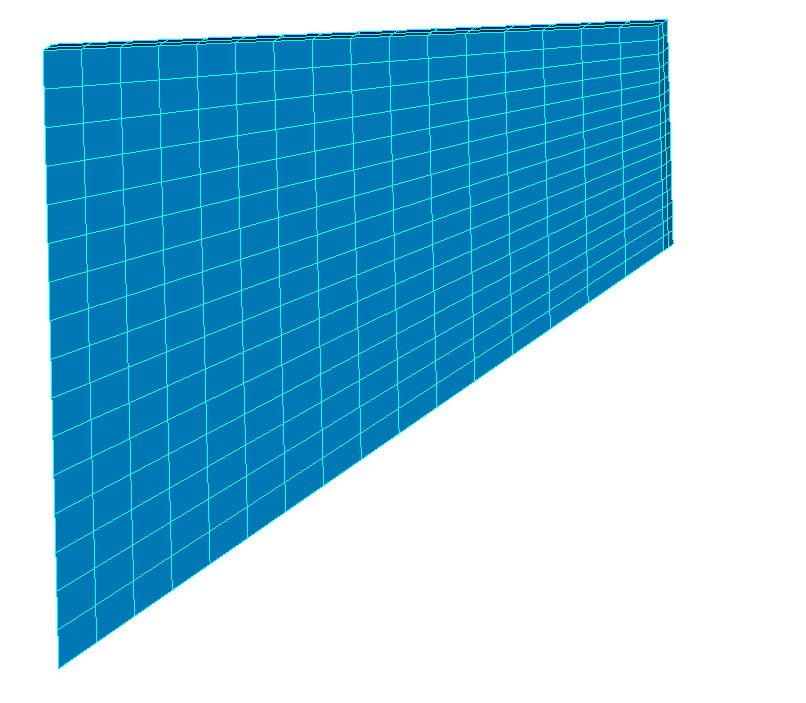
Le maillage est constitué de 512mailles de type HEXA20.
Grandeurs testées et résultats#
On teste les résultats de la modélisation par rapport à la solution numérique de référence présentée en 2 , et également en non-régression.
Lieu |
Instant |
Composante (DEPL) |
VALE_REFE |
Precision |
Nœud A en \((48,60)\) |
\(t=1s\) |
DX |
\(-6.23907\mathit{mm}\) |
1% |
Nœud A en \((48,60)\) |
\(t=1s\) |
DY |
\(7.00031\mathit{mm}\) |
1% |
Identification |
Composante |
Type de référence |
Tolérance |
Nœud A en \((48,60,0.5)\) |
DEPL/DX |
NON_REGRESSION |
0.001% |
Nœud A en \((48,60,0.5)\) |
DEPL/DY |
NON_REGRESSION |
0.001% |
Nœud A en \((48,60,0.5)\) |
SIEQ_ELNO/TRSIG |
NON_REGRESSION |
0.001% |
Nœud C en \((24,30,0)\) |
DEPL/DX |
NON_REGRESSION |
0.001% |
Nœud C en \((24,30,0)\) |
DEPL/DY |
NON_REGRESSION |
0.001% |
Nœud C en \((24,30,0)\) |
SIEQ_ELNO/TRSIG |
NON_REGRESSION |
0.001% |
Modélisation F#
Caractéristiques de la modélisation#
On utilise une modélisation 3D_INCO_UPG
Caractéristiques du maillage#
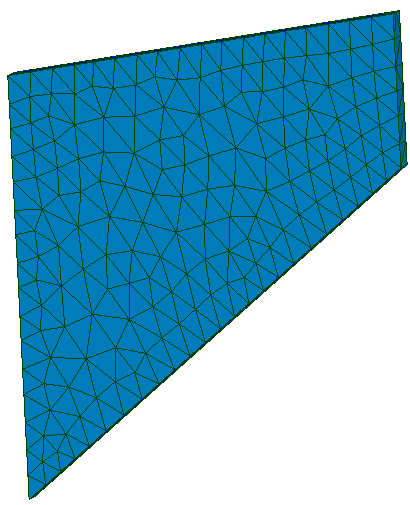
Le maillage est constitué de 1058mailles de type TETRA10.
Grandeurs testées et résultats#
On teste les résultats de la modélisation par rapport à la solution numérique de référence présentée en 2 , et également en non-régression.
Lieu |
Instant |
Composante (DEPL) |
VALE_REFE |
Precision |
Nœud A en \((48,60)\) |
\(t=1s\) |
DX |
\(-6.23907\mathit{mm}\) |
2% |
Nœud A en \((48,60)\) |
\(t=1s\) |
DY |
\(7.00031\mathit{mm}\) |
2% |
Identification |
Composante |
Type de référence |
Tolérance |
Nœud A en \((48,60,0.5)\) |
DEPL/DX |
NON_REGRESSION |
0.001% |
Nœud A en \((48,60,0.5)\) |
DEPL/DY |
NON_REGRESSION |
0.001% |
Nœud A en \((48,60,0.5)\) |
SIEQ_ELNO/TRSIG |
NON_REGRESSION |
0.001% |
Nœud C en \((24,30,0)\) |
DEPL/DX |
NON_REGRESSION |
0.001% |
Nœud C en \((24,30,0)\) |
DEPL/DY |
NON_REGRESSION |
0.001% |
Nœud C en \((24,30,0)\) |
SIEQ_ELNO/TRSIG |
NON_REGRESSION |
0.001% |
Modélisation G#
Caractéristiques de la modélisation#
On utilise une modélisation 3D_HHO_121
Caractéristiques du maillage#
Le maillage est constitué de 512mailles de type HEXA27.
Grandeurs testées et résultats#
On teste les résultats de la modélisation par rapport à la solution numérique de référence présentée en 2 , et également en non-régression.
Lieu |
Instant |
Composante (DEPL) |
VALE_REFE |
Precision |
Nœud A en \((48,60)\) |
\(t=1s\) |
DX |
\(-6.23907\mathit{mm}\) |
3% |
Nœud A en \((48,60)\) |
\(t=1s\) |
DY |
\(7.00031\mathit{mm}\) |
3% |
Identification |
Composante |
Type de référence |
Tolérance |
Nœud A en \((48,60,0.5)\) |
DEPL/DX |
NON_REGRESSION |
0.001% |
Nœud A en \((48,60,0.5)\) |
DEPL/DY |
NON_REGRESSION |
0.001% |
Nœud A en \((48,60,0.5)\) |
SIEQ_ELNO/TRSIG |
NON_REGRESSION |
0.001% |
Nœud C en \((24,30,0)\) |
DEPL/DX |
NON_REGRESSION |
0.001% |
Nœud C en \((24,30,0)\) |
DEPL/DY |
NON_REGRESSION |
0.001% |
Nœud C en \((24,30,0)\) |
SIEQ_ELNO/TRSIG |
NON_REGRESSION |
0.001% |
Modélisation H#
Caractéristiques de la modélisation#
On utilise une modélisation 3D_HHO_222
Caractéristiques du maillage#
Le maillage est constitué de 512mailles de type HEXA27.
Grandeurs testées et résultats#
On teste les résultats de la modélisation par rapport à la solution numérique de référence présentée en 2 , et également en non-régression.
Lieu |
Instant |
Composante (DEPL) |
VALE_REFE |
Precision |
Nœud A en \((48,60)\) |
\(t=1s\) |
DX |
\(-6.23907\mathit{mm}\) |
1% |
Nœud A en \((48,60)\) |
\(t=1s\) |
DY |
\(7.00031\mathit{mm}\) |
1% |
Identification |
Composante |
Type de référence |
Tolérance |
Nœud A en \((48,60,0.5)\) |
DEPL/DX |
NON_REGRESSION |
0.001% |
Nœud A en \((48,60,0.5)\) |
DEPL/DY |
NON_REGRESSION |
0.001% |
Nœud A en \((48,60,0.5)\) |
SIEQ_ELNO/TRSIG |
NON_REGRESSION |
0.001% |
Nœud C en \((24,30,0)\) |
DEPL/DX |
NON_REGRESSION |
0.001% |
Nœud C en \((24,30,0)\) |
DEPL/DY |
NON_REGRESSION |
0.001% |
Nœud C en \((24,30,0)\) |
SIEQ_ELNO/TRSIG |
NON_REGRESSION |
0.001% |
Modélisation I#
Caractéristiques de la modélisation#
On utilise une modélisation 3D_HHO_121
Caractéristiques du maillage#
Le maillage est constitué de 1058mailles de type TETRA8.
Grandeurs testées et résultats#
On teste les résultats de la modélisation par rapport à la solution numérique de référence présentée en 2 , et également en non-régression.
Lieu |
Instant |
Composante (DEPL) |
VALE_REFE |
Précision |
Nœud A en \((48,60,0.5)\) |
\(t=1s\) |
DX |
\(-6.23907\mathit{mm}\) |
0,2 % |
Nœud A en \((48,60,0.5)\) |
\(t=1s\) |
DY |
\(7.00031\mathit{mm}\) |
1% |
Identification |
Composante |
Type de référence |
Tolérance |
Nœud A en \((48,60,0.5)\) |
DEPL/DX |
NON_REGRESSION |
0.001% |
Nœud A en \((48,60,0.5)\) |
DEPL/DY |
NON_REGRESSION |
0.001% |
Nœud A en \((48,60,0.5)\) |
SIEQ_ELNO/TRSIG |
NON_REGRESSION |
0.001% |
Nœud C en \((24,30,0)\) |
DEPL/DX |
NON_REGRESSION |
0.001% |
Nœud C en \((24,30,0)\) |
DEPL/DY |
NON_REGRESSION |
0.001% |
Nœud C en \((24,30,0)\) |
SIEQ_ELNO/TRSIG |
NON_REGRESSION |
0.001% |
Modélisation J#
Caractéristiques de la modélisation#
On utilise une modélisation 3D_HHO_222
Caractéristiques du maillage#
Le maillage est constitué de 1058mailles de type TETRA8.
Grandeurs testées et résultats#
On teste les résultats de la modélisation par rapport à la solution numérique de référence présentée en 2 , et également en non-régression.
Lieu |
Instant |
Composante (DEPL) |
VALE_REFE |
Précision |
Nœud A en \((48,60,0.5)\) |
\(t=1s\) |
DX |
\(-6.23907\mathit{mm}\) |
0.2 % |
Nœud A en \((48,60,0.5)\) |
\(t=1s\) |
DY |
\(7.00031\mathit{mm}\) |
0.2% |
Identification |
Composante |
Type de référence |
Tolérance |
Nœud A en \((48,60,0.5)\) |
DEPL/DX |
NON_REGRESSION |
0.001% |
Nœud A en \((48,60,0.5)\) |
DEPL/DY |
NON_REGRESSION |
0.001% |
Nœud A en \((48,60,0.5)\) |
SIEQ_ELNO/TRSIG |
NON_REGRESSION |
0.001% |
Nœud C en \((24,30,0)\) |
DEPL/DX |
NON_REGRESSION |
0.001% |
Nœud C en \((24,30,0)\) |
DEPL/DY |
NON_REGRESSION |
0.001% |
Nœud C en \((24,30,0)\) |
SIEQ_ELNO/TRSIG |
NON_REGRESSION |
0.001% |
Modélisation K#
Caractéristiques de la modélisation#
On utilise une modélisation D_PLAN_HHO_222
Caractéristiques du maillage#
Le maillage est constitué de mailles de type QUAD8 (quadrangle quadratique), avec un total de 256 éléments.
Grandeurs testées et résultats#
On teste les résultats de la modélisation par rapport à la solution numérique de référence présentée en 2 , et également en non-régression.
Lieu |
Instant |
Composante (DEPL) |
VALE_REFE |
Precision |
Nœud A en \((48,60)\) |
\(t=1s\) |
DX |
\(-6.23907\mathit{mm}\) |
2% |
Nœud A en \((48,60)\) |
\(t=1s\) |
DY |
\(7.00031\mathit{mm}\) |
3% |
Identification |
Composante |
Type de référence |
Tolérance |
Nœud A en \((48,60)\) |
DEPL/DX |
NON_REGRESSION |
0.001% |
Nœud A en \((48,60)\) |
DEPL/DY |
NON_REGRESSION |
0.001% |
Nœud A en \((48,60)\) |
SIEQ_ELNO/TRSIG |
NON_REGRESSION |
0.001% |
Nœud C en \((24,30)\) |
DEPL/DX |
NON_REGRESSION |
0.001% |
Nœud C en \((24,30)\) |
DEPL/DY |
NON_REGRESSION |
0.001% |
Nœud C en \((24,30)\) |
SIEQ_ELNO/TRSIG |
NON_REGRESSION |
0.001% |
Modélisation L#
Caractéristiques de la modélisation#
On utilise une modélisation D_PLAN_HHO_222
Caractéristiques du maillage#
Le maillage est constitué de mailles de type TRIA6 (triangle quadratique), avec un total de 512 éléments.
Grandeurs testées et résultats#
On teste les résultats de la modélisation par rapport à la solution numérique de référence présentée en 2 , et également en non-régression.
Lieu |
Instant |
Composante (DEPL) |
VALE_REFE |
Precision |
Nœud A en \((48,60)\) |
\(t=1s\) |
DX |
\(-6.23907\mathit{mm}\) |
2% |
Nœud A en \((48,60)\) |
\(t=1s\) |
DY |
\(7.00031\mathit{mm}\) |
3% |
Identification |
Composante |
Type de référence |
Tolérance |
Nœud A en \((48,60)\) |
DEPL/DX |
NON_REGRESSION |
0.001% |
Nœud A en \((48,60)\) |
DEPL/DY |
NON_REGRESSION |
0.001% |
Nœud A en \((48,60)\) |
SIEQ_ELNO/TRSIG |
NON_REGRESSION |
0.001% |
Nœud C en \((24,30)\) |
DEPL/DX |
NON_REGRESSION |
0.001% |
Nœud C en \((24,30)\) |
DEPL/DY |
NON_REGRESSION |
0.001% |
Nœud C en \((24,30)\) |
SIEQ_ELNO/TRSIG |
NON_REGRESSION |
0.001% |
Modélisation M#
Caractéristiques de la modélisation#
On utilise une modélisation 3D_HHO_111
Caractéristiques du maillage#
Le maillage est constitué de mailles de type PENTA6 (prismes linéaires convertis en prismes quadratiques par CREA_MAILLAGE), avec un total de 512 éléments. La formulation est linéaire.
Grandeurs testées et résultats#
On teste les résultats de la modélisation par rapport à la solution numérique de référence présentée en 2 , et également en non-régression.
Lieu |
Instant |
Composante (DEPL) |
VALE_REFE |
Précision |
Nœud A en \((48,60,0.5)\) |
\(t=1s\) |
DX |
\(-6.23907\mathit{mm}\) |
1 % |
Nœud A en \((48,60,0.5)\) |
\(t=1s\) |
DY |
\(7.00031\mathit{mm}\) |
1 % |
Identification |
Composante |
Type de référence |
Tolérance |
Nœud A en \((48,60,0.5)\) |
DEPL/DX |
NON_REGRESSION |
0.001% |
Nœud A en \((48,60,0.5)\) |
DEPL/DY |
NON_REGRESSION |
0.001% |
Nœud A en \((48,60,0.5)\) |
SIEQ_ELNO/TRSIG |
NON_REGRESSION |
0.001% |
Nœud C en \((24,30,0)\) |
DEPL/DX |
NON_REGRESSION |
0.001% |
Nœud C en \((24,30,0)\) |
DEPL/DY |
NON_REGRESSION |
0.001% |
Nœud C en \((24,30,0)\) |
SIEQ_ELNO/TRSIG |
NON_REGRESSION |
0.001% |
Modélisation N#
Caractéristiques de la modélisation#
On utilise une modélisation 3D_HHO_111
Caractéristiques du maillage#
Le maillage est constitué de mailles de 256 PENTA6 et 128 HEXA8 (éléments convertis par la suite par CREA_MAILLAGE), avec un total de 384 éléments. La formulation est linéaire.
Grandeurs testées et résultats#
On teste les résultats de la modélisation par rapport à la solution numérique de référence présentée en 2 , et également en non-régression.
Lieu |
Instant |
Composante (DEPL) |
VALE_REFE |
Précision |
Nœud A en \((48,60,0.5)\) |
\(t=1s\) |
DX |
\(-6.23907\mathit{mm}\) |
2 % |
Nœud A en \((48,60,0.5)\) |
\(t=1s\) |
DY |
\(7.00031\mathit{mm}\) |
1 % |
Identification |
Composante |
Type de référence |
Tolérance |
Nœud A en \((48,60,0.5)\) |
DEPL/DX |
NON_REGRESSION |
0.001% |
Nœud A en \((48,60,0.5)\) |
DEPL/DY |
NON_REGRESSION |
0.001% |
Nœud A en \((48,60,0.5)\) |
SIEQ_ELNO/TRSIG |
NON_REGRESSION |
0.001% |
Nœud C en \((24,30,0)\) |
DEPL/DX |
NON_REGRESSION |
0.001% |
Nœud C en \((24,30,0)\) |
DEPL/DY |
NON_REGRESSION |
0.001% |
Nœud C en \((24,30,0)\) |
SIEQ_ELNO/TRSIG |
NON_REGRESSION |
0.001% |
Modélisation O#
Caractéristiques de la modélisation#
On utilise une modélisation 3D_HHO_222
Caractéristiques du maillage#
Le maillage est constitué de mailles de type PYRAM5 (éléments convertis par la suite par CREA_MAILLAGE), avec un total de 1056 éléments. La formulation est quadratique.
Grandeurs testées et résultats#
On teste les résultats de la modélisation par rapport à la solution numérique de référence présentée en 2 , et également en non-régression.
Lieu |
Instant |
Composante (DEPL) |
VALE_REFE |
Précision |
Nœud A en \((48,60,0.5)\) |
\(t=1s\) |
DX |
\(-6.23907\mathit{mm}\) |
2 % |
Nœud A en \((48,60,0.5)\) |
\(t=1s\) |
DY |
\(7.00031\mathit{mm}\) |
2 % |
Identification |
Composante |
Type de référence |
Tolérance |
Nœud A en \((48,60,0.5)\) |
DEPL/DX |
NON_REGRESSION |
0.001 % |
Nœud A en \((48,60,0.5)\) |
DEPL/DY |
NON_REGRESSION |
0.001 % |
Nœud A en \((48,60,0.5)\) |
SIEQ_ELNO/TRSIG |
NON_REGRESSION |
0.001 % |
Nœud C en \((24,30,0)\) |
DEPL/DX |
NON_REGRESSION |
0.001 % |
Nœud C en \((24,30,0)\) |
DEPL/DY |
NON_REGRESSION |
0.001 % |
Nœud C en \((24,30,0)\) |
SIEQ_ELNO/TRSIG |
NON_REGRESSION |
0.001 % |
Modélisation R#
Caractéristiques de la modélisation#
On utilise une modélisation D_PLAN_HHO_333
Caractéristiques du maillage#
Le maillage est constitué de mailles de type QUAD8 (quadrangle quadratique), avec un total de 256 éléments.
Grandeurs testées et résultats#
On teste les résultats de la modélisation par rapport à la solution numérique de référence présentée en 2 , et également en non-régression.
Lieu |
Instant |
Composante (DEPL) |
VALE_REFE |
Precision |
Nœud A en \((48,60)\) |
\(t=1s\) |
DX |
\(-6.23907\mathit{mm}\) |
2% |
Nœud A en \((48,60)\) |
\(t=1s\) |
DY |
\(7.00031\mathit{mm}\) |
3% |
Identification |
Composante |
Type de référence |
Tolérance |
Nœud A en \((48,60)\) |
DEPL/DX |
NON_REGRESSION |
0.001% |
Nœud A en \((48,60)\) |
DEPL/DY |
NON_REGRESSION |
0.001% |
Nœud A en \((48,60)\) |
SIEQ_ELNO/TRSIG |
NON_REGRESSION |
0.001% |
Nœud C en \((24,30)\) |
DEPL/DX |
NON_REGRESSION |
0.001% |
Nœud C en \((24,30)\) |
DEPL/DY |
NON_REGRESSION |
0.001% |
Nœud C en \((24,30)\) |
SIEQ_ELNO/TRSIG |
NON_REGRESSION |
0.001% |
Modélisation S#
Caractéristiques de la modélisation#
On utilise une modélisation D_PLAN_HHO_444
Caractéristiques du maillage#
Le maillage est constitué de mailles de type QUAD8 (quadrangle quadratique), avec un total de 256 éléments.
Grandeurs testées et résultats#
On teste les résultats de la modélisation par rapport à la solution numérique de référence présentée en 2 , et également en non-régression.
Lieu |
Instant |
Composante (DEPL) |
VALE_REFE |
Precision |
Nœud A en \((48,60)\) |
\(t=1s\) |
DX |
\(-6.23907\mathit{mm}\) |
2% |
Nœud A en \((48,60)\) |
\(t=1s\) |
DY |
\(7.00031\mathit{mm}\) |
3% |
Identification |
Composante |
Type de référence |
Tolérance |
Nœud A en \((48,60)\) |
DEPL/DX |
NON_REGRESSION |
0.001% |
Nœud A en \((48,60)\) |
DEPL/DY |
NON_REGRESSION |
0.001% |
Nœud A en \((48,60)\) |
SIEQ_ELNO/TRSIG |
NON_REGRESSION |
0.001% |
Nœud C en \((24,30)\) |
DEPL/DX |
NON_REGRESSION |
0.001% |
Nœud C en \((24,30)\) |
DEPL/DY |
NON_REGRESSION |
0.001% |
Nœud C en \((24,30)\) |
SIEQ_ELNO/TRSIG |
NON_REGRESSION |
0.001% |