

v6.04.116 SSNV116 – POLYCRISTAL steel UMAT law – benchmark with Abaqus#
Summary:
Within SINDRI research project [4] a benchmark between Abaqus and code_aster has been developped based on a Crystal Plasticity Finite Element (CPFE) behaviour law using the formalism of UMAT [1,2].
The geometry is a cube 1x1x1 originated from DREAM3D software which produces synthetic EBSD grains orientations. The sample is submitted to a fixed displacement to one end and clamped on another end.
With this test it is shown that code_aster results compares well to Abaqus.
Reference solution#
Calculation method of the reference solution#
The reference solution is an external software calculation Abaqus FE software. The behaviour law theory has been expanded in the litterature [1,2].
Model A#
Characteristics#
The model A is a linear mesh. code_aster results shown in figure 3. Non-linear deformation «NLGEOM» activated in Abaqus.
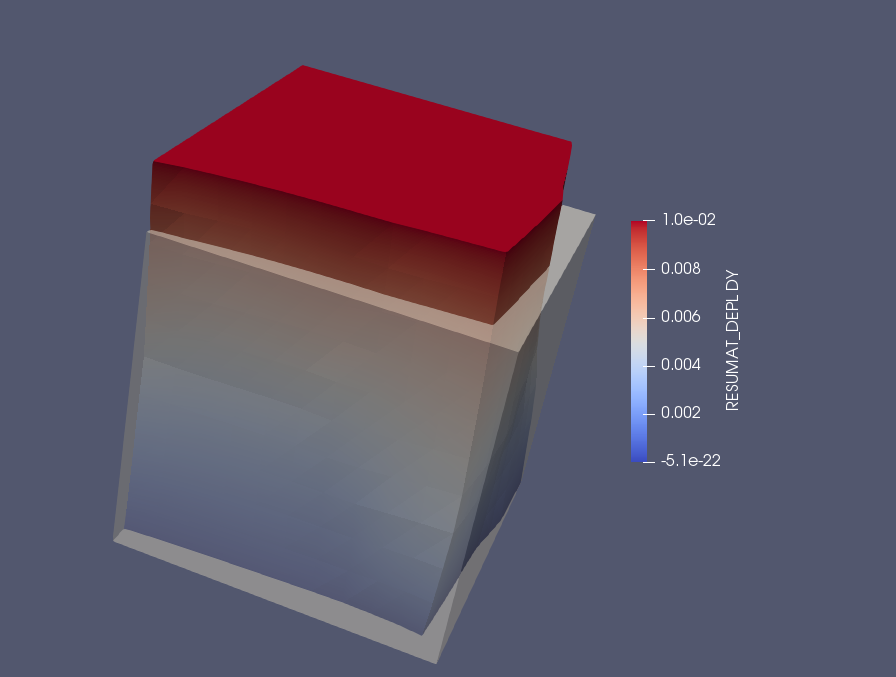
Figure 3: Displacements observed
Fields tested et results#
Identification |
Référence |
Tolérance (%) |
VMIS SIEQ_ELGA (‘el_gr_1’) |
131.8089396414 |
1.E-2 |
Model B#
Characteristics#
The model B demonstrates the velocity dependence of the UMAT law. This test stands as pure numerical test (figure 4). It is the time step which controls the rate of the deformations (Table1).
Test scenarii plotted |
Loading Rate (s) |
Final time (s) |
Total displacement prescribed (\(>\) |
Time steps (s) |
0.1s |
1 |
0.1 |
0.1 |
0.001 |
1s |
0.1 |
1 |
0.1 |
0.01 |
10s |
0.01 |
10 |
0.1 |
0.1 |
100s |
0.001 |
100 |
0.1 |
1 |
1000s |
0.0001 |
1000 |
0.1 |
10 |
10000s |
0.00001 |
10000 |
0.1 |
100 |
Table 1: Table of velocity-dependent rate
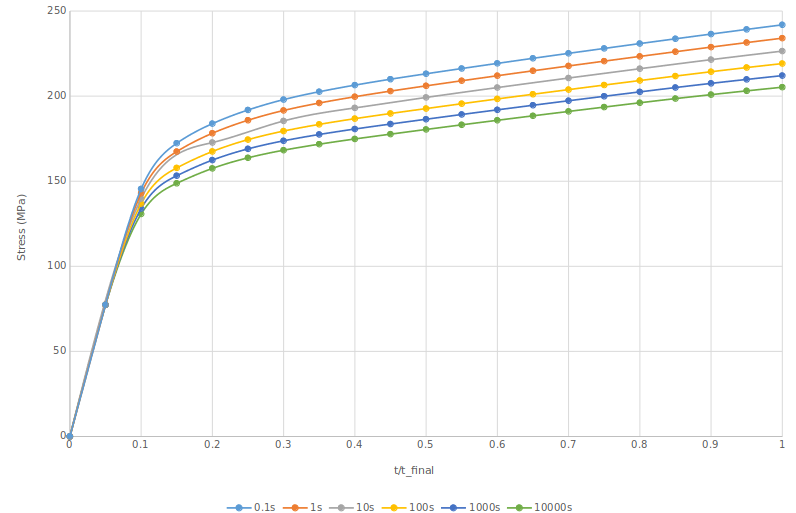
Figure 3: Visco-plasticity results
Fields tested et results#
GROUP_MA=‘GRAIN1’ at t=0.1s
Identification |
Référence |
Tolérance (%) |
VMIS SIEQ_ELGA (0.1s) |
184.089 |
2.5E-1 |
VMIS SIEQ_ELGA (1s) |
184.089 |
2.5E-1 |
VMIS SIEQ_ELGA (10s) |
184.089 |
2.5E-1 |
VMIS SIEQ_ELGA (100s) |
184.089 |
1.5E-1 |
VMIS SIEQ_ELGA (1000s) |
184.089 |
1.5 E-1 |
VMIS SIEQ_ELGA (10000s) |
184.089 |
1.E-4 |
Model C#
Characteristics#
In this test-case a cyclic loading in tension and compression has been applied until 0,5% of deformation during 10 cycles. The aim of this test is to observe the numerical robustness of the UMAT law in compression and tension.
The sample that undergoes the cyclic loading is the same like in MODEL B. The maximal deformation is 0,5% of deformation during 1 second. The simulation runs smoothly, and provide the expected results which are shown in Figure 4. It exhibits the numerical plot of the average displacement extracted at the plane face on which the displacement is imposed.
Figure 4: Cyclic loading results
Fields tested et results#
GROUP_MA=‘GRAIN1’
Identification |
Référence |
Tolérance (%) |
VMIS SIEQ_ELGA (1s) |
190.0009 |
1.E-4 |
VMIS SIEQ_ELGA(2s) |
190.0009 |
2.E-1 |
Model D#
Characteristics#
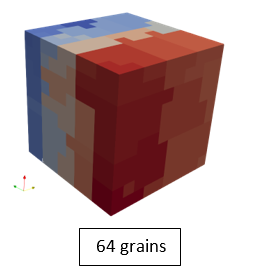
In this test-case 64 grains case is tested.
Fields tested et results#
GROUP_MA=‘GRAIN1’ at t=0.1s. Reference is 8 grains (Model A).
Identification |
Référence |
Tolérance (%) |
VMIS SIEQ_ELGA (64grains) |
131.8089396414 |
1.E-2 |
Concluding remarks#
The results obtained during this benchmark demonstrate:
The capability in code_aster to read the initial UMAT routine developed by University of Bristol for ABAQUS with a good confidence on the results calculated;
The UMAT routine read in code_aster appears to be robust with good computing performance;
Further tests have been performed in code_aster, studying effect of the number of grains and cyclic behaviour. The results obtained meet expectations, both in terms of physical lenghtscale behavior;
The generation of the models have been made using a recently developed automatised process generating Crystal Plasticity Finite Element (CPFE) models from experimental Electron Backscatter Diffraction (EBSD), also developed during the SINDRI project [2]. This demonstrates the effectiveness of this standardized procedure.
Litterature#
[1] Microstructure-informed, predictive crystal plasticity finite element model of fatigue-dwells, Dylan Agius , Abdullah Al Mamuna.
[2] A User-Material subroutine incorporating single crystal plasticity in the Abaqus finite element program, Yonggang Huang
[3] Nanomechanics of Hall–Petch relationship in nanocrystalline materials C.S. Pande, K.P. Cooper, Materials Science and Technology Division, Naval Research Laboratory, Washington, DC 20375-5343, USA
[4] https://southwestnuclearhub.ac.uk/epsrc-funding-sindri-prosperity-partnership/
[5] Latent hardening in single crystals, II. Analytical characterization and predictions, John L. Bassani, Tien-Yue Wuf
[6] https://www.doitpoms.ac.uk/tlplib/work_harden/aims.php
[7] A quantitative study of stress fields ahead of a slip band blocked by a grain boundary in unalloyed magnesium, Mohsen Taheri Andani1,2*, Aaditya Lakshmanan3