

v6.04.259 SSNV259– Circular crack in a solid cylinder under tension#
Summary :
The aim of this test is to verify all keywords of the POST_JMOD macro_command except for ETAT_INIT. The testcase allows the computation of J-integrals in the presence of an initial stress state, within the framework of linear elasticity.
Reference solution#

The analytical SIF solution for this crack geometry (Figure 1) <#page4>`_is given by Eshraghi *et al.* [:ref:`1 <1>]:
\({K}_{I}=\frac{2}{\pi}\sigma \sqrt{\mathit{\pi a}}F\left(\frac{a}{b}\right)\)
where:
\(F\left(\frac{a}{b}\right)=\frac{1-0.5\frac{a}{b}+0.148{\left(\frac{a}{b}\right)}^{3}}{\sqrt{1-\frac{a}{b}}}\)
And the energy release rate for mode I pure reads:
\(J=\frac{{K}_{I}^{2}\times \left(1-{v}^{2}\right)}{E}\)
In this calculation, the input parameters are: a = 2 mm, b = 10 mm, which gives the values of J = 0.118 N/mm.
[1] I. Eshraghi and N. Soltani. Stress intensity factor calculation for internal circumferential cracks in functionally graded cylinders using the weight function approach. Engineering Fracture Mechanics , 134 : 1-19, 2015.
Model A#
Characteristics of the model#
In this model, the crack is meshed (FEM case). The underlying modelisation is 3D.
We use the SYME=YES keyword for the crack.
The result rmed has been generated beforehand.
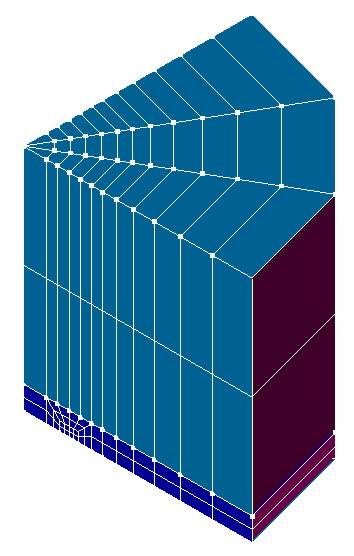
Figure 1.1: mesh of the structure
Characteristics of the mesh#
Number of nodes: 317
Number of cells and type: 562 POI1, 24 SEG2, 9 TRIA3, 239 QUAD4, 12 PENTA6, et 180 HEXA8.
Performed calculations#
The POST_J operator is tested against POST_K1 and CALC_G option G.
Tested values#
Test of the energy release rate:
Identification |
Reference |
Type of reference |
Tolerance |
\(G\) CALC_G option G NUME_PT=1 |
0.118 |
“ANALYTIQUE” |
5% |
\(G\) POST_K1_K2_K3/G NUME_PT=1 |
0.118 |
“ANALYTIQUE” |
5% |
\(J\) POST_JMOD/option J NUME_PT=1 |
0.118 |
“ANALYTIQUE” |
3% |
\(J\) POST_JMOD/option JMOD NUME_PT=1 |
0.118 |
“ANALYTIQUE” |
3% |
\(J\) POST_JMOD/option J NB_POINT_FOND=2 NUME_PT=1 |
0.118 |
“ANALYTIQUE” |
3% |
\(J\) POST_JMOD/option J NB_POINT_FOND=2 and a dummy ETAT_INIT field NUME_PT=1 |
0.118 |
“ANALYTIQUE” |
3% |
Results summary#
This POST_JMOD development allows to calculate J for symmetric and non-symmetric problems, linear and quadratic meshes, opened and closed cracks, linear and non-linear problems (Models A to J).
The solutions are well agreed with the reference ones with a fine mesh (the computation was run on a finer mesh but not provided in this testcase).
POST_JMOD provides in general better results than CALC_G and POST_K1K2K3 and does not significantly depend on the contour.
The desired outputs may be selected for calculating and printing via the options of POST_JMOD.