

r3.01.01 Fonctions de forme et points d’intégration des éléments finis#
Résumé:
On décrit la géométrie et la topologie des éléments finis; pour chaque élément de référence, l’expression des fonctions de forme et les différentes familles de points d’intégration ainsi que les poids associés sont détaillés.
Les éléments linéiques#

Fig. 128 Support géométrique linéique quadratique#
Segments à deux noeuds SE2#
nombre de nœuds |
: 2 |
nombre de nœuds sommets |
: 2 |
fonctions de forme du segment à 2 nœuds:
Segments à trois noeuds SE3#
nombre de nœuds |
: 3 |
nombre de nœuds sommets |
: 2 |
\(x\) |
|
N1 |
-1.0 |
N2 |
1.0 |
N3 |
0.0 |
fonctions de forme du segment à 3 nœuds:
Segments à quatre noeuds SE4#

Fig. 129 Support géométrique linéique cubique#
nombre de nœuds |
: 4 |
nombre de nœuds sommets |
: 2 |
\(x\) |
|
N1 |
-1.0 |
N2 |
1.0 |
N3 |
-1/3 |
N4 |
+1/3 |
fonctions de forme du segment à 4 nœuds:
Nombre de points d’intégration |
Point |
\(x\) |
Poids |
1 |
1 |
0.000000000000000 |
2.000000000000000 |
2 |
1 |
0.577350269189626 |
1.000000000000000 |
2 |
-0.577350269189626 |
1.000000000000000 |
|
3 |
1 |
-0.774596669241000 |
0.000000000000000 |
2 |
0.000000000000000 |
0.000000000000000 |
|
3 |
0.770000000000000 |
0.000000000000000 |
|
4 |
1 |
0.339981043584856 |
0.652145154862546 |
2 |
-0.339981043584856 |
0.652145154862546 |
|
3 |
0.861136311594053 |
0.347854845137454 |
|
4 |
-0.861136311594053 |
0.347854845137454 |
Les éléments surfaciques#
Triangles#
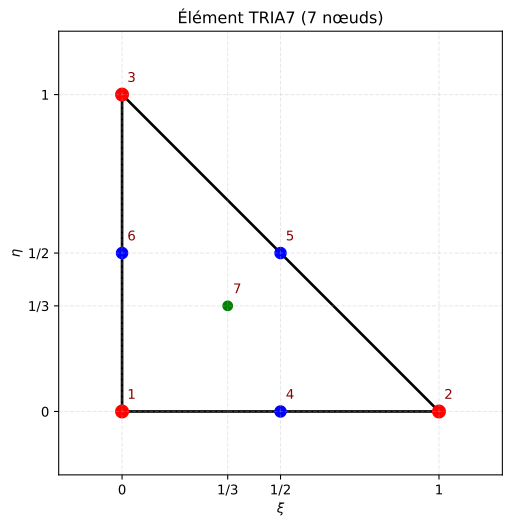
Fig. 130 Support géométrique triangulaire quadratique#
Coordonnées des nœuds:
\(\xi\) |
\(\eta\) |
|
N1 |
0.0 |
0.0 |
N2 |
1.0 |
0.0 |
N3 |
0.0 |
1.0 |
N4 |
0.5 |
0.0 |
N5 |
0.5 |
0.5 |
N6 |
0.0 |
0.5 |
N7 |
1/3 |
1/3 |
Familles d’intégration:
Famille |
Point |
\(\xi\) |
\(\eta\) |
Poids |
FPG1 |
1 |
1/3 |
1/3 |
1/2 |
FPG3 |
1 |
1/6 |
1/6 |
1/6 |
2 |
2/3 |
1/6 |
1/6 |
|
3 |
1/6 |
2/3 |
1/6 |
|
FPG4 |
1 |
1/5 |
1/5 |
25/(24*4) |
2 |
3/5 |
1/5 |
25/(24*4) |
|
3 |
1/5 |
3/5 |
25/(24*4) |
|
4 |
1/3 |
1/3 |
-27/(24*4) |
|
FPG6 |
1 |
b |
b |
P2 |
2 |
1 – 2b |
b |
P2 |
|
3 |
b |
1 – 2b |
P2 |
|
4 |
a |
1 – 2a |
P1 |
|
5 |
a |
a |
P1 |
|
6 |
1 – 2a |
a |
P1 |
|
COT3 |
1 |
1/2 |
1/2 |
1/6 |
2 |
0 |
1/2 |
1/6 |
|
3 |
1/2 |
0 |
1/6 |
avec \(P1 = 0,11169079483905\), \(P2 = 0,0549758718227661\),:math:A = 0,445948490915965 et \(b = 0,091576213509771\)
Famille |
Point |
\(\xi\) |
\(\eta\) |
Poids |
FPG7 |
1 |
1/3 |
1/3 |
9/80 |
2 |
A |
A |
P1 |
|
3 |
1-2A |
A |
P1 |
|
4 |
A |
1-2A |
P1 |
|
5 |
B |
B |
P2 |
|
6 |
1-2B |
B |
P2 |
|
7 |
B |
1-2B |
P2 |
avec \(A = 0.470142064105115\), \(B = 0.101286507323456\), \(P1 = 0.066197076394253\) et \(P2 = 0.062969590272413\)
Famille |
Point |
\(\xi\) |
\(\eta\) |
Poids |
FPG12 |
1 |
A |
A |
P1 |
2 |
1-2A |
A |
P1 |
|
3 |
A |
1-2A |
P1 |
|
4 |
B |
B |
P2 |
|
5 |
1-2B |
B |
P2 |
|
6 |
B |
1-2B |
P2 |
|
7 |
C |
D |
P3 |
|
8 |
D |
C |
P3 |
|
9 |
1-C-D |
C |
P3 |
|
10 |
1-C-D |
D |
P3 |
|
11 |
C |
1-C-D |
P3 |
|
12 |
D |
1-C-D |
P3 |
avec \(A = 0.063089014491502\), \(B = 0.249286745170910\), \(C = 0.310352451033785\), \(D = 0.053145049844816\), \(P1 = 0.025422453185103\), \(P2 = 0.058393137863189\) et \(P3 = 0.041425537809187\).
Triangle à 3 nœuds TR3#
nombre de nœuds |
: 3 |
nombre de nœuds sommets |
: 3 |
Fonctions de forme et dérivées premières du triangle à 3 nœuds:
\(\left\lbrace N\right\rbrace\) |
\(\left\lbrace \partial N/\partial \xi \right\rbrace\) |
\(\left\lbrace \partial N/\partial \eta \right\rbrace\) |
\(1-\xi -\eta\) |
\(-1\) |
\(-1\) |
\(\xi\) |
\(1\) |
\(0\) |
\(\eta\) |
\(0\) |
\(1\) |
Triangle à 6 nœuds TR6#
nombre de nœuds |
: 6 |
nombre de nœuds sommets |
: 3 |
Fonctions de forme et dérivées premières du triangle à 6 nœuds:
\(\left\lbrace N\right\rbrace\) |
\(\left\lbrace \partial N/\partial \xi \right\rbrace\) |
\(\left\lbrace \partial N/\partial \eta \right\rbrace\) |
\(-(1-\xi -\eta )(1-2(1-\xi -\eta ))\) |
\(1-4(1-\xi -\eta )\) |
\(1-4(1-\xi -\eta )\) |
\(-\xi (1-2\xi )\) |
\(-1+4\xi\) |
\(0\) |
\(-\eta (1-2\eta )\) |
\(0\) |
\(-1+4\eta\) |
\(4\xi (1-\xi -\eta )\) |
\(4(1-2\xi -\eta )\) |
\(-4\xi\) |
\(4\xi \eta\) |
\({4\eta }\) |
\(4\xi\) |
\(4\eta (1-\xi -\eta )\) |
\(-4\eta\) |
\(4(1-\xi -2\eta )\) |
Dérivées secondes du triangle à 6 nœuds:
\(\left\lbrace {\partial}^{2}N/\partial {\xi}^{2}\right\rbrace\) |
\(\left\lbrace {\partial}^{2}N/\partial \xi \partial \eta \right\rbrace\) |
\(\left\lbrace {\partial}^{2}N/\partial {\eta}^{2}\right\rbrace\) |
4 |
4 |
4 |
4 |
0 |
0 |
0 |
0 |
4 |
-8 |
-4 |
0 |
0 |
4 |
0 |
0 |
-4 |
-8 |
Triangle à 7 nœuds TR7#
nombre de nœuds |
: 7 |
nombre de nœuds sommets |
: 3 |
Fonctions de forme du triangle à 7 nœuds:
\(\left\lbrace N\right\rbrace\) |
\(1-3(\xi +\eta )+2({\xi}^{2}+{\eta}^{2})+7\xi \eta -3\xi \eta (\xi +\eta )\) |
\(\xi (-1+2\xi +3\eta -3\eta (\xi +\eta ))\) |
\(\eta (-1+2\xi +3\eta -3\xi (\xi +\eta ))\) |
\(4\xi (1-\xi -4\eta +3\eta (\xi +\eta ))\) |
\(4\xi \eta (-2+3(\xi +\eta ))\) |
\(4\eta (1-4\xi -\eta +3\xi (\xi +\eta ))\) |
\(27\xi \eta (1-\xi -\eta )\) |
Dérivées premières du triangle à 7 nœuds:
\(\left\lbrace \partial N/\partial \xi \right\rbrace\) |
\(\left\lbrace \partial N/\partial \eta \right\rbrace\) |
\(-3+4\xi +7\eta -6\xi \eta -3{\eta}^{2}\) |
\(-3+7\xi +4\eta -6\xi \eta -3{\xi}^{2}\) |
\(-1+4\xi +3\eta -6\xi \eta -3{\eta}^{2}\) |
\(3\xi (1-\xi -2\eta )\) |
\(3\xi (1-2\eta -\xi )\) |
\(-1+3\xi +4\eta -6\xi \eta -3{\xi}^{2}\) |
\(4(1-2\xi -4\eta +6\xi \eta +3{\eta}^{2})\) |
\(4\xi (-4+3\xi +6\eta )\) |
\(4\eta (-2+6\xi +3\eta )\) |
\(4\xi (-2+3\xi +6\eta )\) |
\(4\eta (-4+6\xi +3\eta )\) |
\(4(-1-4\xi -2\eta +6\xi \eta +3{\xi}^{2})\) |
\(27\eta (1-2\xi -\eta )\) |
\(27\xi (1-\xi -2\eta )\) |
Dérivées secondes du triangle à 7 nœuds:
\(\left\lbrace {\partial}^{2}N/\partial {\xi}^{2}\right\rbrace\) |
\(\left\lbrace {\partial}^{2}N/\partial \xi \partial \eta \right\rbrace\) |
\(\left\lbrace {\partial}^{2}N/\partial {\eta}^{2}\right\rbrace\) |
\(4-6\eta\) |
\(7-6\xi -6\eta\) |
\(4-6\xi\) |
\(4-6\eta\) |
\(3-6\xi -6\eta\) |
\(-6\xi\) |
\(-6\eta\) |
\(3-6\xi -6\eta\) |
\(4-6\xi\) |
\(4(-2+6\eta )\) |
\(4(-4+6\xi +6\eta )\) |
\(24\xi\) |
\(24\eta\) |
\(4(-2+6\xi +6\eta )\) |
\(24\xi\) |
\(24\eta\) |
\(4(-4+6\xi +6\eta )\) |
\(4(-2+6\xi )\) |
\(-54\eta\) |
\(27(1-2\xi -2\eta )\) |
\(-54\xi\) |
Triangle à 10 nœuds TR1#
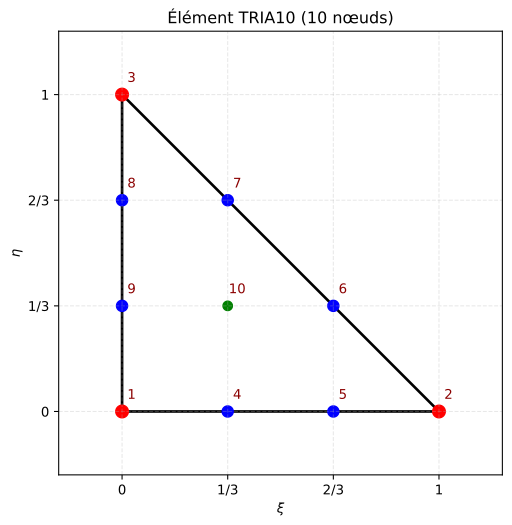
Fig. 131 Support géométrique triangulaire cubique#
nombre de nœuds |
10 |
nombre de nœuds sommets |
3 |
Coordonnées des nœuds:
\(\xi\) |
\(\eta\) |
|
N1 |
0.0 |
0.0 |
N2 |
1.0 |
0.0 |
N3 |
0.0 |
1.0 |
N4 |
1/3 |
0.0 |
N5 |
2/3 |
0.0 |
N6 |
2/3 |
1/3 |
N7 |
1/3 |
2/3 |
N8 |
0.0 |
2/3 |
N9 |
0.0 |
1/3 |
N10 |
1/3 |
1/3 |
Fonctions de forme du triangle à 10 nœuds:
\(\left\lbrace N\right\rbrace\) |
\(-(\eta + \xi - 1)(3\eta + 3\xi - 2)(3\eta + 3\xi - 1)/2\) |
\(\xi(3\xi - 2)(3\xi - 1)/2\) |
\(\eta(3\eta - 2)(3\eta - 1)/2\) |
\(9\xi(\eta + \xi - 1)(3\eta + 3\xi - 2)/2\) |
\(-9\xi(3\xi - 1)(\eta + \xi - 1)/2\) |
\(9\eta\xi(3\xi - 1)/2\) |
\(9\eta\xi(3\eta - 1)/2\) |
\(-9\eta(3\eta - 1)(\eta + \xi - 1)/2\) |
\(9\eta(\eta + \xi - 1)(3\eta + 3\xi - 2)/2\) |
\(-27\eta\xi(\eta + \xi - 1)\) |
Dérivées premières du triangle à 10 nœuds:
\(\left\lbrace \partial N/\partial \xi \right\rbrace\) |
\(\left\lbrace \partial N/\partial \eta \right\rbrace\) |
\(-(27\eta^2 + 54\eta\xi - 36\eta + 27\xi^2 - 36\xi + 11)/2\) |
\(-(27\eta^2 + 54\eta\xi - 36\eta + 27\xi^2 - 36\xi + 11)/2\) |
\((27\xi^2 - 18\xi + 2)/2\) |
\(0\) |
\(0\) |
\((27\eta^2 - 18\eta + 2)/2\) |
\(9(3\eta^2 + 12\eta\xi - 5\eta + 9\xi^2 - 10\xi + 2)/2\) |
\(9\xi(6\eta + 6\xi - 5)/2\) |
\(-9(6\eta\xi - \eta + 9\xi^2 - 8\xi + 1)/2\) |
\(-9\xi(3\xi - 1)/2\) |
\(9\eta(6\xi - 1)/2\) |
\(9\xi(3\xi - 1)/2\) |
\(9\eta(3\eta - 1)/2\) |
\(9\xi(6\eta - 1)/2\) |
\(-9\eta(3\eta - 1)/2\) |
\(-9(9\eta^2 + 6\eta\xi - 8\eta - \xi + 1)/2\) |
\(9\eta(6\eta + 6\xi - 5)/2\) |
\(9(9\eta^2 + 12\eta\xi - 10\eta + 3\xi^2 - 5\xi + 2)/2\) |
\(-27\eta(\eta + 2\xi - 1)\) |
\(-27\xi(2\eta + \xi - 1)\) |
Quadrangles#
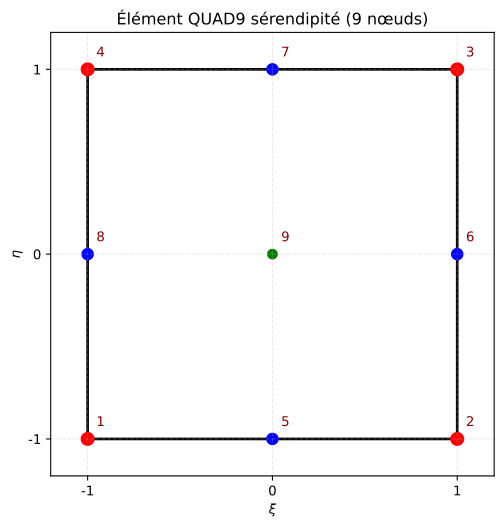
Fig. 132 Support géométrique quadrangulaire quadratique#
Coordonnées des nœuds:
\(\xi\) |
\(\eta\) |
|
N1 |
-1.0 |
-1.0 |
N2 |
1.0 |
-1.0 |
N3 |
1.0 |
1.0 |
N4 |
-1.0 |
1.0 |
N5 |
0.0 |
-1.0 |
N6 |
1.0 |
0.0 |
N7 |
0.0 |
1.0 |
N8 |
-1.0 |
0.0 |
N9 |
0.0 |
0.0 |
Famille |
Point |
\(\xi\) |
\(\eta\) |
Poids |
FPG1 |
1 |
0 |
0 |
4 |
FPG4 |
1 |
\(-a\) |
\(-a\) |
1.0 |
2 |
\(a\) |
\(-a\) |
1.0 |
|
3 |
\(a\) |
\(a\) |
1.0 |
|
4 |
\(-a\) |
\(a\) |
1.0 |
|
FPG9 |
1 |
\(-b\) |
\(-b\) |
25/81 |
2 |
\(b\) |
\(-b\) |
25/81 |
|
3 |
\(b\) |
\(b\) |
25/81 |
|
4 |
\(-b\) |
\(b\) |
25/81 |
|
5 |
0.0 |
\(-b\) |
40/81 |
|
6 |
\(b\) |
0.0 |
40/81 |
|
7 |
0.0 |
b |
40/81 |
|
8 |
\(-b\) |
0.0 |
40/81 |
|
9 |
0.0 |
0.0 |
64/81 |
avec \(a=1/\sqrt{3}\) et \(b=0.774596669241483\)
Quadrangle à 4 nœuds QU4#
nombre de nœuds |
: 4 |
nombre de nœuds sommets |
: 4 |
Fonctions de forme, dérivées premières et secondes du quadrangle à 4 nœuds:
\(\left\lbrace N\right\rbrace\) |
\(\left\lbrace \partial N/\partial \xi \right\rbrace\) |
\(\left\lbrace \partial N/\partial \eta \right\rbrace\) |
\((1-\xi )(1-\eta )/4\) |
\(-(1-\eta )/4\) |
\(-(1-\xi )/4\) |
\((1+\xi )(1-\eta )/4\) |
\((1-\eta )/4\) |
\(-(1+\xi )/4\) |
\((1+\xi )(1+\eta )/4\) |
\((1+\eta )/4\) |
\((1+\xi )/4\) |
\((1-\xi )(1+\eta )/4\) |
\(-(1+\eta )/4\) |
\((1-\xi )/4\) |
\(\left\lbrace {\partial}^{2}N/\partial {\xi}^{2}\right\rbrace\) |
\(\left\lbrace {\partial}^{2}N/\partial \xi \partial \eta \right\rbrace\) |
\(\left\lbrace {\partial}^{2}N/\partial {\eta}^{2}\right\rbrace\) |
0 |
1/4 |
0 |
0 |
-1/4 |
0 |
0 |
1/4 |
0 |
0 |
-1/4 |
0 |
Quadrangle à 8 nœuds QU8#
nombre de nœuds |
: 8 |
nombre de nœuds sommets |
: 4 |
fonctions de forme et dérivées premières du quadrangle à 8 nœuds:
\(\left\lbrace N\right\rbrace\) |
\(\left\lbrace \partial N/\partial \xi \right\rbrace\) |
\(\left\lbrace \partial N/\partial \eta \right\rbrace\) |
\((1-\xi )(1-\eta )(-1-\xi -\eta )/4\) |
\((1-\eta )(2\xi +\eta )/4\) |
\((1-\xi )(\xi +2\eta )/4\) |
\((1+\xi )(1-\eta )(-1+\xi -\eta )/4\) |
\((1-\eta )(2\xi -\eta )/4\) |
\(-(1+\xi )(\xi -2\eta )/4\) |
\((1+\xi )(1+\eta )(-1+\xi +\eta )/4\) |
\((1+\eta )(2\xi +\eta )/4\) |
\((1+\xi )(\xi +2\eta )/4\) |
\((1-\xi )(1+\eta )(-1-\xi +\eta )/4\) |
\(-(1+\eta )(-2\xi +\eta )/4\) |
\((1-\xi )(-\xi +2\eta )/4\) |
\((1-{\xi}^{2})(1-\eta )/2\) |
\(-\xi (1-\eta )\) |
\(-(1-{\xi}^{2})/2\) |
\((1+\xi )(1-{\eta}^{2})/2\) |
\((1-{\eta}^{2})/2\) |
\(-\eta (1+\xi )\) |
\((1-{\xi}^{2})(1+\eta )/2\) |
\(-\xi (1+\eta )\) |
\((1-{\xi}^{2})/2\) |
\((1-\xi )(1-{\eta}^{2})/2\) |
\(-(1-{\eta}^{2})/2\) |
\(-\eta (1-\xi )\) |
dérivées secondes du quadrangle à 8 nœuds:
\(\left\lbrace {\partial}^{2}N/\partial {\xi}^{2}\right\rbrace\) |
\(\left\lbrace {\partial}^{2}N/\partial \xi \partial \eta \right\rbrace\) |
\(\left\lbrace {\partial}^{2}N/\partial {\eta}^{2}\right\rbrace\) |
\((1-\eta )/2\) |
\((1-2\xi -2\eta )/4\) |
\((1-\xi )/2\) |
\((1-\eta )/2\) |
\(-(1+2\xi -2\eta )/4\) |
\((1+\xi )/2\) |
\((1+\eta )/2\) |
\((1+2\xi +2\eta )/4\) |
\((1+\xi )/2\) |
\((1+\eta )/2\) |
\(-(1-2\xi +2\eta )/4\) |
\((1-\xi )/2\) |
\(-1+\eta\) |
\(\xi\) |
\(0\) |
\(0\) |
\(-\eta\) |
\(-1-\xi\) |
\(-1-\eta\) |
\(-\xi\) |
\(0\) |
\(0\) |
\(\eta\) |
\(-1+\xi\) |
Quadrangle à 9 nœuds QU9#
nombre de nœuds |
: 9 |
nombre de nœuds sommets |
: 4 |
fonctions de forme et dérivées premières du quadrangle à 9 nœuds:
\(\left\lbrace N\right\rbrace\) |
\(\left\lbrace \partial N/\partial \xi \right\rbrace\) |
\(\left\lbrace \partial N/\partial \eta \right\rbrace\) |
\(\xi \eta (\xi -1)(\eta -1)/4\) |
\((2\xi -1)\eta (\eta -1)/4\) |
\(\xi (\xi -1)(2\eta -1)/4\) |
\(\xi \eta (\xi +1)(\eta -1)/4\) |
\((2\xi +1)\eta (\eta -1)/4\) |
\(\xi (\xi +1)(2\eta -1)/4\) |
\(\xi \eta (\xi +1)(\eta +1)/4\) |
\((2\xi +1)\eta (\eta +1)/4\) |
\(\xi (\xi +1)(2\eta +1)/4\) |
\(\xi \eta (\xi -1)(\eta +1)/4\) |
\((2\xi -1)\eta (\eta +1)/4\) |
\(\xi (\xi -1)(2\eta +1)/4\) |
\((1-{\xi}^{2})\eta (\eta -1)/2\) |
\(-\xi \eta (\eta -1)\) |
\((1-{\xi}^{2})(2\eta -1)/2\) |
\(\xi (\xi +1)(1-{\eta}^{2})/2\) |
\((2\xi +1)(1-{\eta}^{2})/2\) |
\(-\xi \eta (\xi +1)\) |
\((1-{\xi}^{2})\eta (\eta +1)/2\) |
\(-\xi \eta (\eta +1)\) |
\((1-{\xi}^{2})(2\eta +1)/2\) |
\(\xi (\xi -1)(1-{\eta}^{2})/2\) |
\((2\xi -1)(1-{\eta}^{2})/2\) |
\(-\xi \eta (\xi -1)\) |
\((1-{\xi}^{2})(1-{\eta}^{2})\) |
\(-2\xi (1-{\eta}^{2})\) |
\(-2\eta (1-{\xi}^{2})\) |
dérivées secondes du quadrangle à 9 nœuds:
\(\left\lbrace {\partial}^{2}N/\partial {\xi}^{2}\right\rbrace\) |
\(\left\lbrace {\partial}^{2}N/\partial \xi \partial \eta \right\rbrace\) |
\(\left\lbrace {\partial}^{2}N/\partial {\eta}^{2}\right\rbrace\) |
\(\eta (\eta -1)/2\) |
\((\xi -1/2)(\eta -1/2)\) |
\(\xi (\xi -1)/2\) |
\(\eta (\eta -1)/2\) |
\((\xi +1/2)(\eta -1/2)\) |
\(\xi (\xi +1)/2\) |
\(\eta (\eta +1)/2\) |
\((\xi +1/2)(\eta +1/2)\) |
\(\xi (\xi +1)/2\) |
\(\eta (\eta +1)/2\) |
\((\xi -1/2)(\eta +1/2)\) |
\(\xi (\xi -1)/2\) |
\(-\eta (\eta -1)\) |
\(-\xi (2\eta -1)\) |
\(1-{\xi}^{2}\) |
\(1-{\eta}^{2}\) |
\(-\eta (2\xi +1)\) |
\(-\xi (\xi +1)\) |
\(-\eta (\eta +1)\) |
\(-\xi ({2\eta }+1)\) |
\(1-{\xi}^{2}\) |
\(1-{\eta}^{2}\) |
\(-\eta (2\xi -1)\) |
\(-\xi (\xi -1)\) |
\(-2(1-{\eta}^{2})\) |
\(4\xi \eta\) |
\(-2(1-{\xi}^{2})\) |
Quadrangle à 12 nœuds Q12#
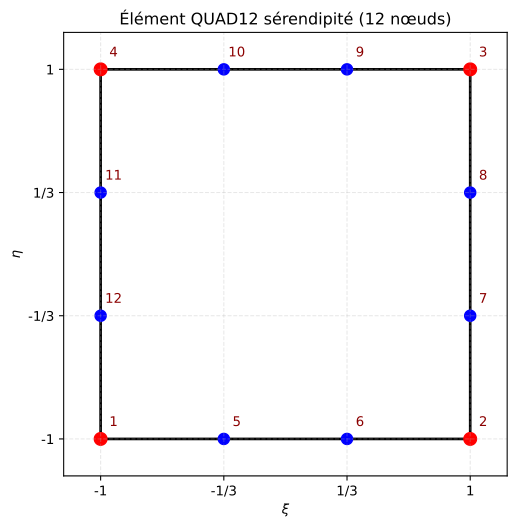
Fig. 133 Support géométrique quadrangulaire cubique#
nombre de nœuds |
12 |
nombre de nœuds sommets |
4 |
Coordonnées des nœuds:
\(\xi\) |
\(\eta\) |
|
N1 |
-1.0 |
-1.0 |
N2 |
1.0 |
-1.0 |
N3 |
1.0 |
1.0 |
N4 |
-1.0 |
1.0 |
N5 |
-1/3 |
-1.0 |
N6 |
1/3 |
-1.0 |
N7 |
1.0 |
-1/3 |
N8 |
1.0 |
1/3 |
N9 |
1/3 |
1.0 |
N10 |
-1/3 |
1.0 |
N11 |
-1.0 |
1/3 |
N12 |
-1.0 |
-1/3 |
fonctions de forme du quadrangle à 12 nœuds:
\(\left\lbrace N\right\rbrace\) |
\((\eta - 1)(\xi - 1)(9\eta^2 + 9\xi^2 - 10)/32\) |
\(-(\eta - 1)(\xi + 1)(9\eta^2 + 9\xi^2 - 10)/32\) |
\((\eta + 1)(\xi + 1)(9\eta^2 + 9\xi^2 - 10)/32\) |
\(-(\eta + 1)(\xi - 1)(9\eta^2 + 9\xi^2 - 10)/32\) |
\(-9(\eta - 1)(\xi - 1)(\xi + 1)(3\xi - 1)/32\) |
\(9(\eta - 1)(\xi - 1)(\xi + 1)(3\xi + 1)/32\) |
\(9(\eta - 1)(\eta + 1)(3\eta - 1)(\xi + 1)/32\) |
\(-9(\eta - 1)(\eta + 1)(3\eta + 1)(\xi + 1)/32\) |
\(-9(\eta + 1)(\xi - 1)(\xi + 1)(3\xi + 1)/32\) |
\(9(\eta + 1)(\xi - 1)(\xi + 1)(3\xi - 1)/32\) |
\(9(\eta - 1)(\eta + 1)(3\eta + 1)(\xi - 1)/32\) |
\(-9(\eta - 1)(\eta + 1)(3\eta - 1)(\xi - 1)/32\) |
dérivées premières du quadrangle à 12 nœuds:
\(\left\lbrace \partial N/\partial \xi \right\rbrace\) |
\(\left\lbrace \partial N/\partial \eta \right\rbrace\) |
\((\eta - 1)(9\eta^2 + 27\xi^2 - 18\xi - 10)/32\) |
\((\xi - 1)(27\eta^2 - 18\eta + 9\xi^2 - 10)/32\) |
\(-(\eta - 1)(9\eta^2 + 27\xi^2 + 18\xi - 10)/32\) |
\(-(\xi + 1)(27\eta^2 - 18\eta + 9\xi^2 - 10)/32\) |
\((\eta + 1)(9\eta^2 + 27\xi^2 + 18\xi - 10)/32\) |
\((\xi + 1)(27\eta^2 + 18\eta + 9\xi^2 - 10)/32\) |
\(-(\eta + 1)(9\eta^2 + 27\xi^2 - 18\xi - 10)/32\) |
\(-(\xi - 1)(27\eta^2 + 18\eta + 9\xi^2 - 10)/32\) |
\(-9(\eta - 1)(9\xi^2 - 2\xi - 3)/32\) |
\(-9(\xi - 1)(\xi + 1)(3\xi - 1)/32\) |
\(9(\eta - 1)(9\xi^2 + 2\xi - 3)/32\) |
\(9(\xi - 1)(\xi + 1)(3\xi + 1)/32\) |
\(9(\eta - 1)(\eta + 1)(3\eta - 1)/32\) |
\(9(\xi + 1)(9\eta^2 - 2\eta - 3)/32\) |
\(-9(\eta - 1)(\eta + 1)(3\eta + 1)/32\) |
\(-9(\xi + 1)(9\eta^2 + 2\eta - 3)/32\) |
\(-9(\eta + 1)(9\xi^2 + 2\xi - 3)/32\) |
\(-9(\xi - 1)(\xi + 1)(3\xi + 1)/32\) |
\(9(\eta + 1)(9\xi^2 - 2\xi - 3)/32\) |
\(9(\xi - 1)(\xi + 1)(3\xi - 1)/32\) |
\(9(\eta - 1)(\eta + 1)(3\eta + 1)/32\) |
\(9(\xi - 1)(9\eta^2 + 2\eta - 3)/32\) |
\(-9(\eta - 1)(\eta + 1)(3\eta - 1)/32\) |
\(-9(\xi - 1)(9\eta^2 - 2\eta - 3)/32\) |
Les éléments volumiques#
Les tétraèdres linéaires et quadratiques#
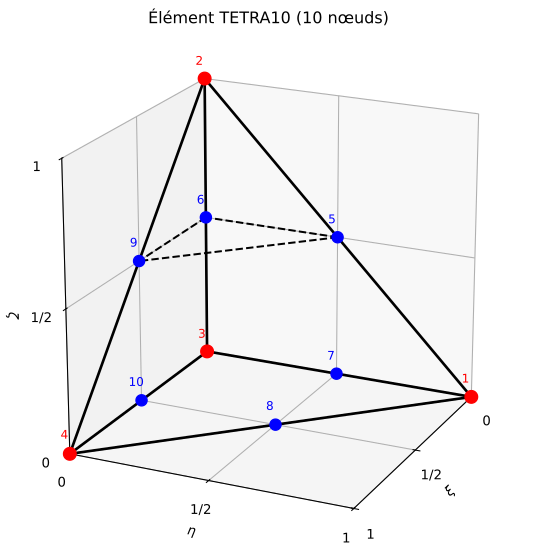
Fig. 134 Support géométrique tétraédrique quadratique#
Coordonnées des nœuds:
\(x\) |
\(y\) |
\(z\) |
|
N1 |
|||
N2 |
|||
N3 |
|||
N4 |
|||
N5 |
0.5 |
0.5 |
|
N6 |
0.5 |
||
N7 |
0.5 |
||
N8 |
0.5 |
0.5 |
|
N9 |
0.5 |
0.5 |
|
N10 |
0.5 |
Fonctions de forme pour 4 nœuds
Fonctions de forme pour 10 nœuds
Formule d’intégration à 1 point, du premier ordre en \(x,y,z\) : FPG1
Point |
\(x\) |
\(y\) |
\(z\) |
Poids |
1 |
\(1/4\) |
\(1/4\) |
\(1/4\) |
\(1/6\) |
Formule d’intégration à 4 points, du deuxième ordre en \(x,y,z\) : FPG4
Point |
\(x\) |
\(y\) |
\(z\) |
Poids |
1 |
\(a\) |
\(a\) |
\(a\) |
\(1/24\) |
2 |
\(a\) |
\(a\) |
\(b\) |
\(1/24\) |
3 |
\(a\) |
\(b\) |
\(a\) |
\(1/24\) |
4 |
\(b\) |
\(a\) |
\(a\) |
\(1/24\) |
avec: \(a=\frac{5-\sqrt{5}}{20}\) , \(b=\frac{5+3\sqrt{5}}{20}\)
Formule d’intégration à 5 points, du troisième ordre en \(x,y,z\) : FPG5
Point |
\(x\) |
\(y\) |
\(z\) |
Poids |
1 |
\(a\) |
\(a\) |
\(a\) |
\(-2/15\) |
2 |
\(b\) |
\(b\) |
\(b\) |
\(3/40\) |
3 |
\(b\) |
\(b\) |
\(c\) |
\(3/40\) |
4 |
\(b\) |
\(c\) |
\(b\) |
\(3/40\) |
5 |
\(c\) |
\(b\) |
\(b\) |
\(3/40\) |
avec: \(a=0.25\) , \(b=\frac{1}{6}\) , \(c=0.5\)
Formule d’intégration à 15 points, du cinquième ordre en \(x,y,z\) : FPG15
Point |
\(x\) |
\(y\) |
\(z\) |
Poids |
1 |
\(a\) |
\(a\) |
\(a\) |
\(8/405\) |
2;3;4;5 |
\({b}_{1}\) ; \({b}_{1}\) ; \({b}_{1}\) ; \({c}_{1}\) |
\({b}_{1}\) ; \({b}_{1}\) ; \({c}_{1}\) ; \({b}_{1}\) |
\({b}_{1}\) ; \({c}_{1}\) ; \({b}_{1}\) ; \({b}_{1}\) |
\(\frac{2665-14\sqrt{15}}{226800}\) |
6;7;8;9 |
\({b}_{2}\) ; \({b}_{2}\) ; \({b}_{2}\) ; \({c}_{2}\) |
\({b}_{2}\) ; \({b}_{2}\) ; \({c}_{2}\) ; \({b}_{2}\) |
\({b}_{2}\) ; \({c}_{2}\) ; \({b}_{2}\) ; \({b}_{2}\) |
\(\frac{2665+14\sqrt{15}}{226800}\) |
10;11;12;13;14;15 |
\(d\) ; \(d\) ; \(e\) ; \(d\) ; \(e\) ; \(e\) |
\(d\) ; \(e\) ; \(d\) ; \(e\) ; \(d\) ; \(e\) |
\(e\) ; \(d\) ; \(d\) ; \(e\) ; \(e\) ; \(d\) |
\(\frac{5}{567}\) |
avec \(a=0.25\), \({b}_{1}=\frac{7+\sqrt{15}}{34}\), \({b}_{2}=\frac{7-\sqrt{15}}{34}\), \({c}_{1}=\frac{13-3\sqrt{15}}{34}\), \({c}_{2}=\frac{13+3\sqrt{15}}{34}\), \(d=\frac{5-\sqrt{15}}{20}\) et \(e=\frac{5+\sqrt{15}}{20}\)
Les tétraèdres cubiques#
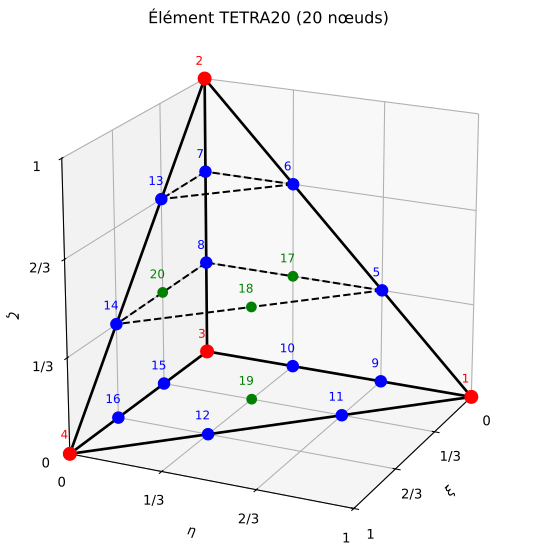
Fig. 135 Support géométrique tétraédrique cubique#
nombre de nœuds |
20 |
nombre de nœuds sommets |
4 |
Coordonnées des nœuds:
\(\xi\) |
\(\eta\) |
\(\zeta\) |
|
N1 |
0.0 |
1.0 |
0.0 |
N2 |
0.0 |
0.0 |
1.0 |
N3 |
0.0 |
0.0 |
0.0 |
N4 |
1.0 |
0.0 |
0.0 |
N5 |
0.0 |
2/3 |
1/3 |
N6 |
0.0 |
1/3 |
2/3 |
N7 |
0.0 |
0.0 |
2/3 |
N8 |
0.0 |
0.0 |
1/3 |
N9 |
0.0 |
2/3 |
0.0 |
N10 |
0.0 |
1/3 |
0.0 |
N11 |
1/3 |
2/3 |
0.0 |
N12 |
2/3 |
1/3 |
0.0 |
N13 |
1/3 |
0.0 |
2/3 |
N14 |
2/3 |
0.0 |
1/3 |
N15 |
1/3 |
0.0 |
0.0 |
N16 |
2/3 |
0.0 |
0.0 |
N17 |
0.0 |
1/3 |
1/3 |
N18 |
1/3 |
1/3 |
1/3 |
N19 |
1/3 |
1/3 |
0.0 |
N20 |
1/3 |
0.0 |
1/3 |
fonctions de forme du tétraèdres à 20 nœuds:
\(\left\lbrace N\right\rbrace\) |
\(\eta(3\eta - 2)(3\eta - 1)/2\) |
\(\zeta(3\zeta - 2)(3\zeta - 1)/2\) |
\(-(\eta + \xi + \zeta - 1)(3\eta + 3\xi + 3\zeta - 2)(3\eta + 3\xi + 3\zeta - 1)/2\) |
\(\xi(3\xi - 2)(3\xi - 1)/2\) |
\(9\eta\zeta(3\eta - 1)/2\) |
\(9\eta\zeta(3\zeta - 1)/2\) |
\(-9\zeta(3\zeta - 1)(\eta + \xi + \zeta - 1)/2\) |
\(9\zeta(\eta + \xi + \zeta - 1)(3\eta + 3\xi + 3\zeta - 2)/2\) |
\(-9\eta(3\eta - 1)(\eta + \xi + \zeta - 1)/2\) |
\(9\eta(\eta + \xi + \zeta - 1)(3\eta + 3\xi + 3\zeta - 2)/2\) |
\(9\eta\xi(3\eta - 1)/2\) |
\(9\eta\xi(3\xi - 1)/2\) |
\(9\xi\zeta(3\zeta - 1)/2\) |
\(9\xi\zeta(3\xi - 1)/2\) |
\(9\xi(\eta + \xi + \zeta - 1)(3\eta + 3\xi + 3\zeta - 2)/2\) |
\(-9\xi(3\xi - 1)(\eta + \xi + \zeta - 1)/2\) |
\(-27\eta\zeta(\eta + \xi + \zeta - 1)\) |
\(27\eta\xi\zeta\) |
\(-27\eta\xi(\eta + \xi + \zeta - 1)\) |
\(-27\xi\zeta(\eta + \xi + \zeta - 1)\) |
Les pentaèdres#
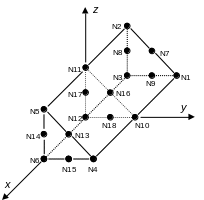
Fig. 136 Support géométrique pentaédrique#
Coordonnées des nœuds:
\(x\) |
\(y\) |
\(z\) |
|
N1 |
-1. |
||
N2 |
-1. |
||
N3 |
-1. |
||
N4 |
|||
N5 |
|||
N6 |
|||
N7 |
-1. |
0.5 |
0.5. |
N8 |
-1. |
0.5. |
|
N9 |
-1. |
0.5 |
|
N10 |
|||
N11 |
|||
N12 |
|||
N13 |
0.5 |
0.5 |
|
N14 |
0.5 |
||
N15 |
0.5 |
||
N16 |
0.5 |
0.5 |
|
N17 |
0.5 |
||
N18 |
0.5 |
||
N19 |
-1. |
1/3 |
1/3 |
N20 |
1/3 |
1/3 |
|
N21 |
1/3 |
1/3 |
Fonctions de forme, formule à 6 nœuds
Fonctions de forme, formule à 15 nœuds
Fonctions de forme, formule à 18 nœuds
Formules d’intégration numérique à 6 points (ordre 3 en \(x\) , ordre 2 en \(y\) et \(z\) ) (FPG6)
Point |
\(x\) |
\(y\) |
\(z\) |
Poids |
1 |
\(-1/\sqrt{3}\) |
0.5 |
0.5 |
\(1/6\) |
2 |
\(-1/\sqrt{3}\) |
0.5 |
\(1/6\) |
|
3 |
\(-1/\sqrt{3}\) |
0.5 |
\(1/6\) |
|
4 |
\(1/\sqrt{3}\) |
0.5 |
0.5 |
\(1/6\) |
5 |
\(1/\sqrt{3}\) |
0.5 |
\(1/6\) |
|
6 |
\(1/\sqrt{3}\) |
0.5 |
\(1/6\) |
Formule d’intégration numérique à 8 points (FPG8)
2 points de Gauss en \(x\) (ordre 3).
4 points de Hammer en \(y\) et \(z\) (ordre 3).
Point |
\(x\) |
\(y\) |
\(z\) |
Poids |
1 |
\(-a\) |
\(1/3\) |
\(1/3\) |
\(-27/96\) |
2 |
\(-a\) |
0.6 |
0.2 |
\(25/96\) |
3 |
\(-a\) |
0.2 |
0.6 |
\(25/96\) |
4 |
\(-a\) |
0.2 |
0.2 |
\(25/96\) |
5 |
\(+a\) |
\(1/3\) |
\(1/3\) |
\(-27/96\) |
6 |
\(+a\) |
0.6 |
0.2 |
\(25/96\) |
7 |
\(+a\) |
0.2 |
0.6 |
\(25/96\) |
8 |
\(+a\) |
0.2 |
0.2 |
\(25/96\) |
avec \(a=0.577350269189626\)
Formule d’intégration numérique à 21 points (FPG21)
3 points de Gauss en \(x\) (ordre 5).
7 points de Hammer en \(y\) et \(z\) (ordre 5 en \(y\) et \(z\) ).
Point |
\(x\) |
\(y\) |
\(z\) |
Poids |
1 |
\(-\alpha\) |
\(1/3\) |
\(1/3\) |
\({c}_{1}\frac{9}{80}\) |
2;3;4 |
\(-\alpha\) ; \(-\alpha\) ; \(-\alpha\) |
\(a\) ; \(1-2a\) ; \(a\) |
\(a\) ; \(a\) ; \(1-2a\) |
\({c}_{1}(\frac{155+\sqrt{15}}{2400})\) |
5;6;7 |
\(-\alpha\) ; \(-\alpha\) ; \(-\alpha\) |
\(b\) ; \(1-2b\) ; \(b\) |
\(b\) ; \(b\) ; \(1-2b\) |
\({c}_{1}(\frac{155-\sqrt{15}}{2400})\) |
8 |
\(1/3\) |
\(1/3\) |
\({c}_{2}\frac{9}{80}\) |
|
9;10;11 |
0.;0.;0. |
\(a\) ; \(1-2a\) ; \(a\) |
\(a\) ; \(a\) ; \(1-2a\) |
\({c}_{2}(\frac{155+\sqrt{15}}{2400})\) |
12;13;14 |
0.;0.;0. |
\(b\) ; \(1-2b\) ; \(b\) |
\(b\) ; \(b\) ; \(1-2b\) |
\({c}_{2}(\frac{155-\sqrt{15}}{2400})\) |
15 |
\(\alpha\) |
\(1/3\) |
\(1/3\) |
\({c}_{1}\frac{9}{80}\) |
16;17;18 |
\(\alpha\) ; \(\alpha\) ; \(\alpha\) |
\(b\) ; \(1-2a\) ; \(a\) |
\(a\) ; \(a\) ; \(1-2a\) |
\({c}_{1}(\frac{155+\sqrt{15}}{2400})\) |
19;20;21 |
\(\alpha\) ; \(\alpha\) ; \(\alpha\) |
\(b\) ; \(1-2b\) ; \(b\) |
\(b\) ; \(b\) ; \(1-2b\) |
\({c}_{1}(\frac{155-\sqrt{15}}{2400})\) |
avec \(\alpha =\sqrt{\frac{3}{5}}\), \({c}_{1}=\frac{5}{9}\), \({c}_{2}=\frac{8}{9}\), \(a=\frac{6+\sqrt{15}}{21}\) et \(b=\frac{6-\sqrt{15}}{21}\).
Formule d’intégration numérique à 27 points (FPG27): voir [bib3].
Point |
\(x\) |
\(y\) |
\(z\) |
Poids |
1 |
0.0 |
0.895512822481133 |
0.052243588759434 |
0.027191062410231 |
2 |
0.0 |
0.052243588759434 |
0.895512822481133 |
0.027191062410231 |
3 |
0.0 |
0.052243588759434 |
0.052243588759434 |
0.027191062410231 |
4 |
0.0 |
0.198304865473555 |
0.270635256143164 |
0.040636041641220 |
5 |
0.0 |
0.198304865473555 |
0.531059878383280 |
0.040636041641220 |
6 |
0.0 |
0.270635256143164 |
0.531059878383280 |
0.040636041641220 |
7 |
0.0 |
0.531059878383280 |
0.270635256143164 |
0.040636041641220 |
8 |
0.0 |
0.531059878383280 |
0.198304865473555 |
0.040636041641220 |
9 |
0.0 |
0.270635256143164 |
0.198304865473555 |
0.040636041641220 |
10 |
0.936241512371697 |
0.333333333333333 |
0.333333333333333 |
0.050275140937507 |
11 |
0.948681147283254 |
0.841699897299232 |
0.079150051350384 |
0.011774414962347 |
12 |
0.948681147283254 |
0.079150051350384 |
0.841699897299232 |
0.011774414962347 |
13 |
0.948681147283254 |
0.079150051350384 |
0.079150051350384 |
0.011774414962347 |
14 |
0.600638052820557 |
0.054831294873304 |
0.308513201856883 |
0.041951149272741 |
15 |
0.600638052820557 |
0.054831294873304 |
0.636655503269814 |
0.041951149272741 |
16 |
0.600638052820557 |
0.308513201856883 |
0.636655503269814 |
0.041951149272741 |
17 |
0.600638052820557 |
0.636655503269814 |
0.308513201856883 |
0.041951149272741 |
18 |
0.600638052820557 |
0.636655503269814 |
0.054831294873304 |
0.041951149272741 |
19 |
0.600638052820557 |
0.308513201856883 |
0.054831294873304 |
0.041951149272741 |
20 |
-0.936241512371697 |
0.333333333333333 |
0.333333333333333 |
0.050275140937507 |
21 |
-0.948681147283254 |
0.841699897299232 |
0.079150051350384 |
0.011774414962347 |
22 |
-0.948681147283254 |
0.079150051350384 |
0.841699897299232 |
0.011774414962347 |
23 |
-0.948681147283254 |
0.079150051350384 |
0.079150051350384 |
0.011774414962347 |
24 |
-0.600638052820557 |
0.054831294873304 |
0.308513201856883 |
0.041951149272741 |
25 |
-0.600638052820557 |
0.054831294873304 |
0.636655503269814 |
0.041951149272741 |
26 |
-0.600638052820557 |
0.308513201856883 |
0.636655503269814 |
0.041951149272741 |
27 |
-0.600638052820557 |
0.636655503269814 |
0.308513201856883 |
0.041951149272741 |
28 |
-0.600638052820557 |
0.636655503269814 |
0.054831294873304 |
0.041951149272741 |
29 |
-0.600638052820557 |
0.308513201856883 |
0.054831294873304 |
0.041951149272741 |
Les hexaèdres linéaires et quadratiques#
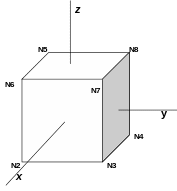
Fig. 137 Support géométrique hexaédrique linéaire#
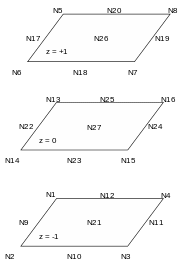
Fig. 138 Support géométrique hexaédrique quadratique#
Coordonnées des nœuds:
\(x\) |
\(y\) |
\(z\) |
|
N1 |
-1. |
-1. |
-1. |
N2 |
-1. |
-1. |
|
N3 |
-1. |
||
N4 |
-1. |
-1. |
|
N5 |
-1. |
-1. |
|
N6 |
-1. |
||
N7 |
|||
N8 |
-1. |
||
N9 |
-1. |
-1. |
|
N10 |
-1. |
||
N11 |
-1. |
||
N12 |
-1. |
-1. |
|
N13 |
-1. |
-1. |
|
N14 |
-1. |
||
N15 |
|||
N16 |
-1. |
||
N17 |
-1. |
||
N18 |
|||
N19 |
|||
N20 |
-1. |
||
N21 |
-1. |
||
N22 |
-1. |
||
N23 |
|||
N24 |
|||
N25 |
-1. |
||
N26 |
|||
N27 |
Fonctions de forme, formule à 8 nœuds
Fonctions de forme, formule à 20 nœuds
Fonctions de forme, formule à 27 nœuds
Formule de quadrature de Gauss à 2 points dans chaque direction (ordre 3): FPG8
Point |
\(x\) |
\(y\) |
\(z\) |
Poids |
1 |
\(-1/\sqrt{3}\) |
\(-1/\sqrt{3}\) |
\(-1/\sqrt{3}\) |
|
2 |
\(-1/\sqrt{3}\) |
\(-1/\sqrt{3}\) |
\(1/\sqrt{3}\) |
|
3 |
\(-1/\sqrt{3}\) |
\(1/\sqrt{3}\) |
\(-1/\sqrt{3}\) |
|
4 |
\(-1/\sqrt{3}\) |
\(1/\sqrt{3}\) |
\(1/\sqrt{3}\) |
|
5 |
\(1/\sqrt{3}\) |
\(-1/\sqrt{3}\) |
\(-1/\sqrt{3}\) |
|
6 |
\(1/\sqrt{3}\) |
\(-1/\sqrt{3}\) |
\(1/\sqrt{3}\) |
|
7 |
\(1/\sqrt{3}\) |
\(1/\sqrt{3}\) |
\(-1/\sqrt{3}\) |
|
8 |
\(1/\sqrt{3}\) |
\(1/\sqrt{3}\) |
\(1/\sqrt{3}\) |
Formule de quadrature de Gauss à 3 points dans chaque direction (ordre 5): FPG27
Point |
\(x\) |
\(y\) |
\(z\) |
Poids |
1 |
\(-\alpha\) |
\(-\alpha\) |
\(-\alpha\) |
\({c}_{1}^{3}\) |
2 |
\(-\alpha\) |
\(-\alpha\) |
\({c}_{1}^{2}{c}_{2}\) |
|
3 |
\(-\alpha\) |
\(-\alpha\) |
\(\alpha\) |
\({c}_{1}^{3}\) |
4 |
\(-\alpha\) |
\(-\alpha\) |
\({c}_{1}^{2}{c}_{2}\) |
|
5 |
\(-\alpha\) |
\({c}_{1}{c}_{2}^{2}\) |
||
6 |
\(-\alpha\) |
\(\alpha\) |
\({c}_{1}^{2}{c}_{2}\) |
|
7 |
\(-\alpha\) |
\(\alpha\) |
\(-\alpha\) |
\({c}_{1}^{3}\) |
8 |
\(-\alpha\) |
\(\alpha\) |
\({c}_{1}^{2}{c}_{2}\) |
|
9 |
\(-\alpha\) |
\(\alpha\) |
\(\alpha\) |
\({c}_{1}^{3}\) |
10 |
\(-\alpha\) |
\(-\alpha\) |
\({c}_{1}^{2}{c}_{2}\) |
|
11 |
\(-\alpha\) |
\({c}_{1}{c}_{2}^{2}\) |
||
12 |
\(-\alpha\) |
\(\alpha\) |
\({c}_{1}^{2}{c}_{2}\) |
|
13 |
\(-\alpha\) |
\({c}_{1}{c}_{2}^{2}\) |
||
14 |
\({c}_{2}^{3}\) |
|||
15 |
\(\alpha\) |
\({c}_{1}{c}_{2}^{2}\) |
||
16 |
\(\alpha\) |
\(-\alpha\) |
\({c}_{1}^{2}{c}_{2}\) |
|
17 |
\(\alpha\) |
\({c}_{1}{c}_{2}^{2}\) |
||
18 |
\(\alpha\) |
\(\alpha\) |
\({c}_{1}^{2}{c}_{2}\) |
|
19 |
\(\alpha\) |
\(-\alpha\) |
\(-\alpha\) |
\({c}_{1}^{3}\) |
20 |
\(\alpha\) |
\(-\alpha\) |
\({c}_{1}^{2}{c}_{2}\) |
|
21 |
\(\alpha\) |
\(-\alpha\) |
\(\alpha\) |
\({c}_{1}^{3}\) |
22 |
\(\alpha\) |
\(-\alpha\) |
\({c}_{1}^{2}{c}_{2}\) |
|
23 |
\(\alpha\) |
\({c}_{1}{c}_{2}^{2}\) |
||
24 |
\(\alpha\) |
\(\alpha\) |
\({c}_{1}^{2}{c}_{2}\) |
|
25 |
\(\alpha\) |
\(\alpha\) |
\(-\alpha\) |
\({c}_{1}^{3}\) |
26 |
\(\alpha\) |
\(\alpha\) |
\({c}_{1}^{2}{c}_{2}\) |
|
27 |
\(\alpha\) |
\(\alpha\) |
\(\alpha\) |
\({c}_{1}^{3}\) |
avec \(\alpha =\sqrt{\frac{3}{5}}\), \({c}_{1}=\frac{5}{9}\) et \({c}_{2}=\frac{8}{9}\).
Les pyramides linéaires et quadratiques#
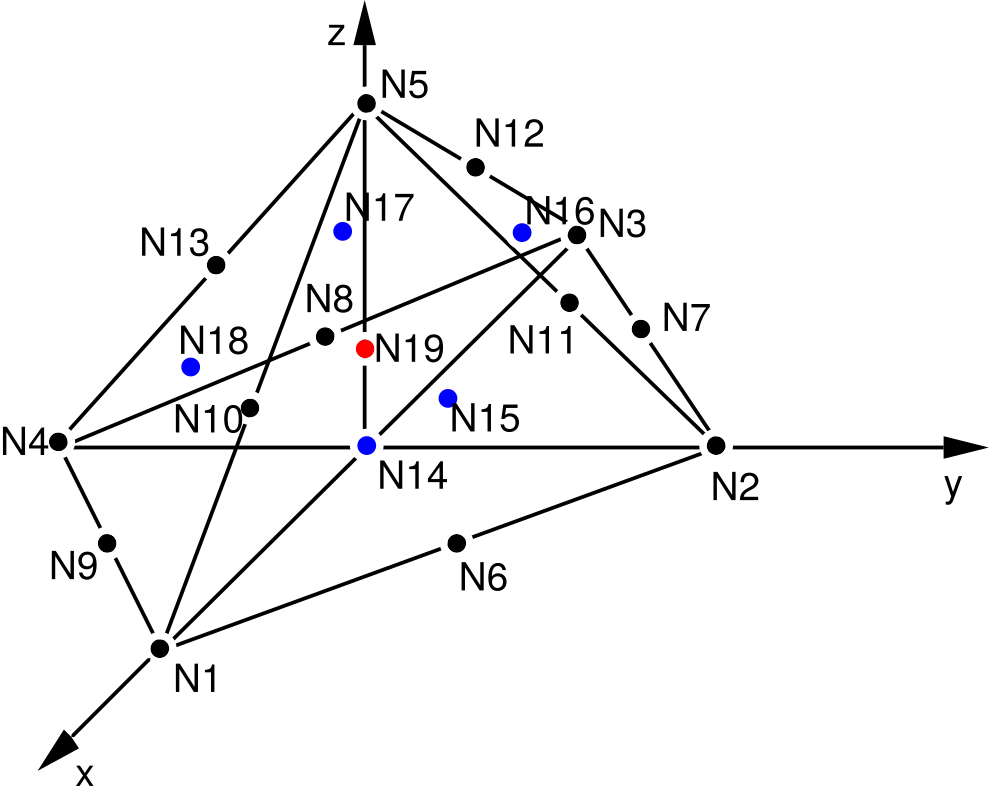
Fig. 139 Support géométrique pyramide quadratique#
Les nœuds en bleu sont au milieu des faces, celui en rouge au milieu de la cellule.
La base carrée est constituée par le quadrangle \({N}_{1}-{N}_{2}-{N}_{3}-{N}_{4}\) et \({N}_{5}\) est le sommet de la pyramide.
\(x\) |
\(y\) |
\(z\) |
|
N1 |
|||
N2 |
|||
N3 |
–1. |
||
N4 |
–1. |
||
N5 |
|||
N6 |
0.5 |
0.5 |
|
N7 |
–0.5 |
0.5 |
|
N8 |
–0.5 |
–0.5 |
|
N9 |
0.5 |
–0.5 |
|
N10 |
0.5 |
0.5 |
|
N11 |
0.5 |
0.5 |
|
N12 |
–0.5 |
0.5 |
|
N13 |
–0.5 |
0.5 |
|
N14 |
0 |
||
N15 |
1/3 |
1/3 |
1/3 |
N16 |
-1/3 |
1/3 |
1/3 |
N17 |
-1/3 |
-1/3 |
1/3 |
N18 |
1/3 |
-1/3 |
1/3 |
N19 |
0 |
0 |
0.2 |
Fonctions de forme, formule à 5 nœuds
Formule à 13 nœuds
Formule d’intégration numérique à 5 points du deuxième ordre (FPG5):
Point |
\(x\) |
\(y\) |
\(z\) |
Poids |
1 |
\(0,5\) |
\(0\) |
\({h}_{1}\) |
\({p}_{1}\) |
2 |
\(0\) |
\(0,5\) |
\({h}_{1}\) |
\({p}_{1}\) |
3 |
\(–0,5\) |
\(0\) |
\({h}_{1}\) |
\({p}_{1}\) |
4 |
\(0\) |
\(–0,5\) |
\({h}_{1}\) |
\({p}_{1}\) |
5 |
\(0\) |
\(0\) |
\({h}_{1}\) |
\({p}_{1}\) |
avec \({h}_{1}=0.1531754163448146\), \({h}_{2}=0.6372983346207416\) et \({p}_{1}=\frac{2}{15}\).
Formule d’intégration numérique à 6 points du troisième ordre (FPG6):
Point |
\(x\) |
\(y\) |
\(z\) |
Poids |
1 |
\(0\) |
\(0\) |
\({h}_{1}\) |
\({p}_{1}\) |
2 |
\(0\) |
\(0\) |
\({h}_{2}\) |
\({p}_{2}\) |
3 |
\(–a\) |
\(0\) |
\({h}_{3}\) |
\({p}_{3}\) |
4 |
\(0\) |
\(–a\) |
\({h}_{3}\) |
\({p}_{3}\) |
5 |
\(0\) |
\(a\) |
\({h}_{3}\) |
\({p}_{3}\) |
6 |
\(a\) |
\(0\) |
\({h}_{3}\) |
\({p}_{3}\) |
avec \(a=0.5610836110587396\), \({p}_{1}=0.1681372559485071\), \({p}_{2}=0.07500000404404333\), \({p}_{3}=0.1058823516685291\), \({h}_{1}=0.1681372559485071\), \({h}_{2}=0.00000000567585\) et \({h}_{3}=0.1058823516685291\).
Formule d’intégration numérique à 10 points (FPG10) d’ordre 4, voir [bib2] :
Point |
\(x\) |
\(y\) |
\(z\) |
Poids |
1 |
\(0\) |
\(0\) |
\({h}_{1}\) |
\({w}_{1}\) |
2 |
\(0\) |
\(0\) |
\({h}_{2}\) |
\({w}_{2}\) |
3 |
\(-a\) |
\(-a\) |
\({h}_{3}\) |
\({w}_{3}\) |
4 |
\(-a\) |
\(a\) |
\({h}_{3}\) |
\({w}_{3}\) |
5 |
\(a\) |
\(a\) |
\({h}_{3}\) |
\({w}_{3}\) |
6 |
\(a\) |
\(-a\) |
\({h}_{3}\) |
\({w}_{3}\) |
7 |
\(-b\) |
\(0\) |
\({h}_{4}\) |
\({w}_{4}\) |
8 |
\(0\) |
\(-b\) |
\({h}_{4}\) |
\({w}_{4}\) |
9 |
\(0\) |
\(b\) |
\({h}_{4}\) |
\({w}_{4}\) |
10 |
\(b\) |
\(0\) |
\({h}_{4}\) |
\({w}_{4}\) |
avec \(a=0.3252907781991163\), \(b=0.65796699712169\), \({h}_{1}=0.6772327888861374\), \({h}_{2}=0.1251369531087465\), \({h}_{3}=0.3223841495782137\), \({h}_{4}=0.0392482838988154\), \({w}_{1}=0.07582792211376127\), \({w}_{2}=0.1379222683930349\), \({w}_{3}=0.07088305859288367\) et \({w}_{4}=0.04234606044708394\).
Formule d’intégration numérique à 15 points de Gauss (FPG15) du cinquième ordre:
Point |
\(x\) |
\(y\) |
\(z\) |
Poids |
1 |
0.0 |
0.0 |
0.7298578807825067 |
0.04562357993942674 |
2 |
0.0 |
0.0 |
0.300401020813769 |
0.112931409661816 |
3 |
0.0 |
0.0 |
0.0000000064917722 |
0.03913635721904967 |
4 |
-0.3532630157731623 |
-0.3532630157731623 |
0.125 |
0.05096086209874681 |
5 |
-0.3532630157731623 |
0.3532630157731623 |
0.125 |
0.05096086209874681 |
6 |
0.3532630157731623 |
0.3532630157731623 |
0.125 |
0.05096086209874681 |
7 |
0.3532630157731623 |
-0.3532630157731623 |
0.125 |
0.05096086209874681 |
8 |
-0.7051171227788277 |
0.531059878383280 |
0.061111907062023 |
0.02644726771976367 |
9 |
0.0 |
-0.7051171227788277 |
0.061111907062023 |
0.02644726771976367 |
10 |
0.0 |
0.7051171227788277 |
0.061111907062023 |
0.02644726771976367 |
11 |
0.7051171227788277 |
0.0 |
0.061111907062023 |
0.02644726771976367 |
12 |
-0.432882864103541 |
0.0 |
0.4236013371197248 |
0.011774414962347 |
13 |
0.0 |
-0.432882864103541 |
0.4236013371197248 |
0.011774414962347 |
14 |
0.0 |
0.432882864103541 |
0.4236013371197248 |
0.041951149272741 |
15 |
0.432882864103541 |
0.0 |
0.4236013371197248 |
0.041951149272741 |
Formule d’intégration numérique à 24 points de Gauss (FPG24) d’ordre 6:
Point |
\(x\) |
\(y\) |
\(z\) |
Poids |
1 |
0.0 |
0.0 |
0.8076457976939595 |
0.01697526244176133 |
2 |
0.0 |
0.0 |
0.0017638088528196 |
0.0107023421167942 |
3 |
0.0 |
0.0 |
0.1382628064637306 |
0.0797197029683492 |
4 |
0.0 |
0.0 |
0.4214239119356371 |
0.0687071134661012 |
5 |
-0.4172976755573542 |
-0.4172976755573542 |
0.097447341025462 |
0.02463372529088633 |
6 |
-0.4172976755573542 |
0.4172976755573542 |
0.097447341025462 |
0.02463372529088633 |
7 |
0.4172976755573542 |
0.4172976755573542 |
0.097447341025462 |
0.02463372529088633 |
8 |
0.4172976755573542 |
-0.4172976755573542 |
0.097447341025462 |
0.02463372529088633 |
9 |
-0.2169627046883496 |
-0.2169627046883496 |
0.5660745906233009 |
0.02105838632544886 |
10 |
-0.2169627046883496 |
0.2169627046883496 |
0.5660745906233009 |
0.02105838632544886 |
11 |
0.2169627046883496 |
0.2169627046883496 |
0.5660745906233009 |
0.02105838632544886 |
12 |
0.2169627046883496 |
-0.2169627046883496 |
0.5660745906233009 |
0.02105838632544886 |
13 |
-0.5656808544256755 |
0.0 |
0.0294777308457207 |
0.0248000862596322 |
14 |
0.0 |
-0.5656808544256755 |
0.0294777308457207 |
0.0248000862596322 |
15 |
0.0 |
0.5656808544256755 |
0.0294777308457207 |
0.0248000862596322 |
16 |
0.5656808544256755 |
0.0 |
0.0294777308457207 |
0.0248000862596322 |
17 |
-0.498079091780705 |
0.0 |
0.2649158632121295 |
0.04925492311795127 |
18 |
0.0 |
-0.498079091780705 |
0.2649158632121295 |
0.04925492311795127 |
19 |
0.0 |
0.498079091780705 |
0.2649158632121295 |
0.04925492311795127 |
20 |
0.498079091780705 |
0.0 |
0.2649158632121295 |
0.04925492311795127 |
21 |
-0.9508994872144825 |
0.0 |
0.048249070631936 |
0.0028934404244966 |
22 |
0.0 |
-0.9508994872144825 |
0.048249070631936 |
0.0028934404244966 |
23 |
0.0 |
0.9508994872144825 |
0.048249070631936 |
0.0028934404244966 |
24 |
0.9508994872144825 |
0.0 |
0.048249070631936 |
0.0028934404244966 |
Bibliographie#
DHATT G., TOUZOT G.: Une présentation de la méthode des éléments finis 2ème édition. Editeur: MALOINE S.A. Année 1984
Freddie Witherden, Peter Vincent: On the identification of symmetric quadrature rules for finite element methods, Computers and Mathematics with Applications, Volume 69, pages 1232-1241, 2015.
KUBATKO, YAEGER, MAGGI: New computationally efficient quadrature formulas for triangular prism elements. Computers & Fluids 73 (2013) 187-201