

v6.04.144 SSNV144 - Coude en flexion en grands déplacements#
Résumé:
Ce test valide la modélisation des phénomènes de flexion de coque en grands déplacements dans le domaine élastique ou élastoplastique : un coude de tuyauterie, prolongé par des tuyaux droits est soumis à une flexion dans son plan. La tuyauterie est épaisse (de dimensions semblables aux coudes des circuits primaires). La solution de référence est numérique: elle est obtenue avec Code_Aster à l’aide d’un maillage \(\mathrm{3D}\) du coude.
La modélisation est effectuée avec des éléments COQUE_3D en grands déplacements ou en élastoplasticité.
Solution de référence#
Méthode de calcul utilisée pour la solution de référence#
En élasticité linéaire, cf [V6.02.117] on effectue une comparaison à d’autres résultats numériques obtenus avec Code_Aster sur un maillage \(\mathrm{3D}\) du coude et des parties droites, reliées aux extrémités à des poutres droites. Ce maillage \(\mathrm{3D}\) comporte 1024 mailles HEXA20. Une modélisation COQUE_3D donne des résultats proches.
Résultats de référence#
Pour un moment appliqué \(\mathrm{Mz}\) en \(D\) , le déplacement \(\mathrm{DY}\) du même point \(D\) vaut:
Moment |
\(\mathit{DY}\) point \(D\) ( \(m\) ) ( 3D ) |
\(\mathit{DY}\) point \(D\) ( \(m\) ) ( COQUE_3D ) |
3.08670D+08 |
1.09349D–02 |
1.08875D–02 |
Incertitude sur la solution#
Du fait que la solution de référence est numérique, on peut évaluer la précision d’après [§2.2] à \(\text{2\%}\) par comparaison des solutions \(\mathrm{3D}\) et COQUE_3D.
Modélisation A#
Caractéristiques de la modélisation#
COQUE_3D
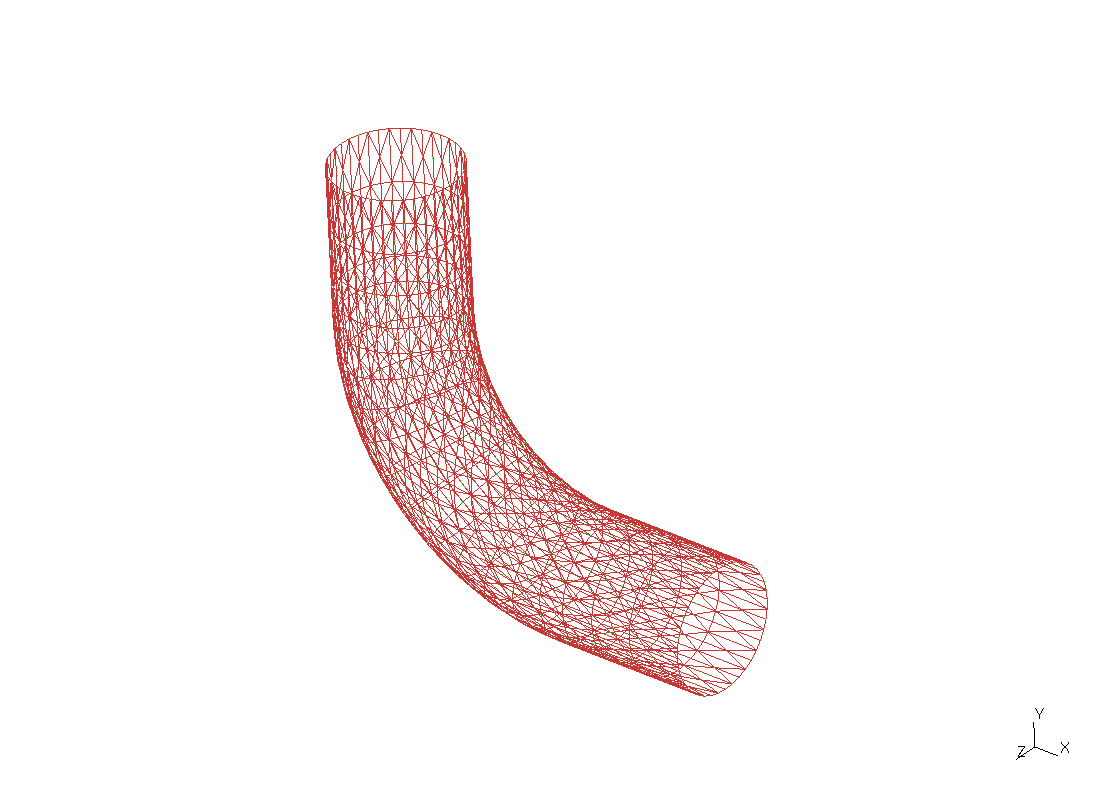
Caractéristiques du maillage#
Nombre de nœuds : 1480
Nombre de mailles et type : 360 QUAD9
Grandeurs testées et résultats de la modélisation A#
Pour comparer les résultats du calcul élastique linéaire (MECA_STATIQUE) avec la solution de référence, on compare les déplacements de 4 nœuds de la section du tube correspondant au point \(D\) (\(\mathrm{CERCLE2}\) ).
Incrément de charge |
\(\mathrm{DY}\) du point \(D\) |
\(\mathrm{Mz}=\mathrm{3.08670D}+\mathrm{06Nm}\) |
\(\mathrm{DY}\) (\(m\) ) |
Calcul linéaire :
Emplacement |
Valeur à tester |
Type de test |
Tolérance |
\(\mathit{N1157}\) – \(\mathit{DX}\) |
6.51271E-04 |
NON_REGRESSION |
6.49E-06 % |
\(\mathit{N1104}\) – \(\mathit{DX}\) |
1.28830E-04 |
NON_REGRESSION |
1.88E-04 % |
\(\mathit{N1109}\) – \(\mathit{DX}\) |
4.01834E-04 |
NON_REGRESSION |
1.61E-05 % |
\(\mathit{N1099}\) – \(\mathit{DX}\) |
4.01834E-04 |
NON_REGRESSION |
1.61E-05 % |
\(\mathit{N1157}\) – \(\mathit{DY}\) |
1.08154E-03 |
NON_REGRESSION |
9.44E-05 % |
\(\mathit{N1104}\) – \(\mathit{DY}\) |
1.09424E-03 |
NON_REGRESSION |
3.15E-04 % |
\(\mathit{N1109}\) – \(\mathit{DY}\) |
1.08427E-03 |
NON_REGRESSION |
2.92E-04 % |
\(\mathit{N1099}\) – \(\mathit{DY}\) |
1.08427E-03 |
NON_REGRESSION |
2.92E-04 % |
\(\mathit{N1157}\) – \(\mathit{DZ}\) |
0.00000E+00 |
NON_REGRESSION |
1.00E-08 % |
\(\mathit{N1104}\) – \(\mathit{DZ}\) |
0.00000E+00 |
NON_REGRESSION |
1.00E-08 % |
\(\mathit{N1109}\) – \(\mathit{DZ}\) |
6.34660E-06 |
NON_REGRESSION |
8.70E-06 % |
\(\mathit{N1099}\) – \(\mathit{DZ}\) |
-6.34660E-06 |
NON_REGRESSION |
8.69E-06 % |
\(\mathit{N1157}\) – \(\mathit{DRX}\) |
0.00000E+00 |
NON_REGRESSION |
1.00E-08 % |
\(\mathit{N1104}\) – \(\mathit{DRX}\) |
0.00000E+00 |
NON_REGRESSION |
1.00E-08 % |
\(\mathit{N1109}\) – \(\mathit{DRX}\) |
-8.06992E-06 |
NON_REGRESSION |
7.78E-06 % |
\(\mathit{N1099}\) – \(\mathit{DRX}\) |
8.06992E-06 |
NON_REGRESSION |
7.78E-06 % |
\(\mathit{N1157}\) – \(\mathit{DRY}\) |
0.00000E+00 |
NON_REGRESSION |
1.00E-08 % |
\(\mathit{N1104}\) – \(\mathit{DRY}\) |
0.00000E+00 |
NON_REGRESSION |
1.00E-08 % |
\(\mathit{N1109}\) – \(\mathit{DRY}\) |
-4.85229E-05 |
NON_REGRESSION |
5.35E-05 % |
\(\mathit{N1099}\) – \(\mathit{DRY}\) |
4.85229E-05 |
NON_REGRESSION |
5.35E-05 % |
\(\mathit{N1157}\) – \(\mathit{DRZ}\) |
5.84655E-04 |
NON_REGRESSION |
6.51E-05 % |
\(\mathit{N1104}\) – \(\mathit{DRZ}\) |
6.81747E-04 |
NON_REGRESSION |
5.81E-05 % |
\(\mathit{N1109}\) – \(\mathit{DRZ}\) |
-9.39844E-05 |
NON_REGRESSION |
6.63E-06 % |
\(\mathit{N1099}\) – \(\mathit{DRZ}\) |
-9.39844E-05 |
NON_REGRESSION |
6.63E-06 % |
Calcul élastoplastique (non régression)
Emplacement |
Valeur à tester |
Type de test |
Tolérance |
\(\mathit{N1157}\) – \(\mathit{DX}\) |
6.51271E-04 |
NON_REGRESSION |
0.160 % |
\(\mathit{N1104}\) – \(\mathit{DX}\) |
1.28830E-04 |
NON_REGRESSION |
0.028 % |
\(\mathit{N1109}\) – \(\mathit{DX}\) |
4.01834E-04 |
NON_REGRESSION |
0.149 % |
\(\mathit{N1099}\) – \(\mathit{DX}\) |
4.01834E-04 |
NON_REGRESSION |
0.149 % |
\(\mathit{N1157}\) – \(\mathit{DY}\) |
1.08154E-03 |
NON_REGRESSION |
0.209 % |
\(\mathit{N1104}\) – \(\mathit{DY}\) |
1.09424E-03 |
NON_REGRESSION |
0.206 % |
\(\mathit{N1109}\) – \(\mathit{DY}\) |
1.08427E-03 |
NON_REGRESSION |
0.208 % |
\(\mathit{N1099}\) – \(\mathit{DY}\) |
1.08427E-03 |
NON_REGRESSION |
0.208 % |
\(\mathit{N1157}\) – \(\mathit{DZ}\) |
0.00000E+00 |
NON_REGRESSION |
1.00000E-08 % |
\(\mathit{N1104}\) – \(\mathit{DZ}\) |
0.00000E+00 |
NON_REGRESSION |
1.00000E-08 % |
\(\mathit{N1109}\) – \(\mathit{DZ}\) |
6.34660E-06 |
NON_REGRESSION |
0.022 % |
\(\mathit{N1099}\) – \(\mathit{DZ}\) |
-6.34660E-06 |
NON_REGRESSION |
0.022 % |
\(\mathit{N1157}\) – \(\mathit{DRX}\) |
0.00000E+00 |
NON_REGRESSION |
1.00000E-08 % |
\(\mathit{N1104}\) – \(\mathit{DRX}\) |
0.00000E+00 |
NON_REGRESSION |
1.00000E-08 % |
\(\mathit{N1109}\) – \(\mathit{DRX}\) |
-8.06992E-06 |
NON_REGRESSION |
0.382 % |
\(\mathit{N1099}\) – \(\mathit{DRX}\) |
8.06992E-06 |
NON_REGRESSION |
0.382 % |
\(\mathit{N1157}\) – \(\mathit{DRY}\) |
0.00000E+00 |
NON_REGRESSION |
1.00000E-08 % |
\(\mathit{N1104}\) – \(\mathit{DRY}\) |
0.00000E+00 |
NON_REGRESSION |
1.00000E-08 % |
\(\mathit{N1109}\) – \(\mathit{DRY}\) |
-4.85229E-05 |
NON_REGRESSION |
0.533 % |
\(\mathit{N1099}\) – \(\mathit{DRY}\) |
4.85229E-05 |
NON_REGRESSION |
0.533 % |
\(\mathit{N1157}\) – \(\mathit{DRZ}\) |
5.84655E-04 |
NON_REGRESSION |
0.173 % |
\(\mathit{N1104}\) – \(\mathit{DRZ}\) |
6.81747E-04 |
NON_REGRESSION |
0.224 % |
\(\mathit{N1109}\) – \(\mathit{DRZ}\) |
-9.39844E-05 |
NON_REGRESSION |
0.533 % |
\(\mathit{N1099}\) – \(\mathit{DRZ}\) |
-9.39844E-05 |
NON_REGRESSION |
0.533 % |
On teste aussi en non-régression le nombre total d’itérations de Newton:
Paramètre |
Valeur à tester |
Type de test |
Tolérance |
EVOL_NOLI – ITER_GLOB |
1 |
NON_REGRESSION |
0 |
Calcul grands déplacements (non régression):
Emplacement |
NUME_ORDRE |
Valeur à tester |
Type de test |
Tolérance |
\(\mathit{N1157}\) – \(\mathit{DX}\) |
10 |
6.51271E-04 |
NON_REGRESSION |
0.161% |
\(\mathit{N1104}\) – \(\mathit{DX}\) |
10 |
1.28830E-04 |
NON_REGRESSION |
0.274 % |
\(\mathit{N1109}\) – \(\mathit{DX}\) |
10 |
4.01834E-04 |
NON_REGRESSION |
0.169 % |
\(\mathit{N1099}\) – \(\mathit{DX}\) |
10 |
4.01834E-04 |
NON_REGRESSION |
0.169 % |
\(\mathit{N1157}\) – \(\mathit{DY}\) |
10 |
1.08154E-03 |
NON_REGRESSION |
0.164% |
\(\mathit{N1104}\) – \(\mathit{DY}\) |
10 |
1.09424E-03 |
NON_REGRESSION |
0.115 % |
\(\mathit{N1109}\) – \(\mathit{DY}\) |
10 |
1.08427E-03 |
NON_REGRESSION |
0.139 % |
\(\mathit{N1099}\) – \(\mathit{DY}\) |
10 |
1.08427E-03 |
NON_REGRESSION |
0.139 % |
\(\mathit{N1157}\) – \(\mathit{DZ}\) |
10 |
0.00000E+00 |
NON_REGRESSION |
1.00000E-08 % |
\(\mathit{N1104}\) – \(\mathit{DZ}\) |
10 |
0.00000E+00 |
NON_REGRESSION |
1.00000E-08 % |
\(\mathit{N1109}\) – \(\mathit{DZ}\) |
10 |
6.34660E-06 |
NON_REGRESSION |
4.398 % |
\(\mathit{N1099}\) – \(\mathit{DZ}\) |
10 |
-6.34660E-06 |
NON_REGRESSION |
4.398 % |
\(\mathit{N1157}\) – \(\mathit{DRX}\) |
10 |
0.00000E+00 |
NON_REGRESSION |
1.00000E-08 % |
\(\mathit{N1104}\) – \(\mathit{DRX}\) |
10 |
0.00000E+00 |
NON_REGRESSION |
1.00000E-08 % |
\(\mathit{N1109}\) – \(\mathit{DRX}\) |
10 |
-8.06992E-06 |
NON_REGRESSION |
0.423 % |
\(\mathit{N1099}\) – \(\mathit{DRX}\) |
10 |
8.06992E-06 |
NON_REGRESSION |
0.423 % |
\(\mathit{N1157}\) – \(\mathit{DRY}\) |
10 |
0.00000E+00 |
NON_REGRESSION |
1.00000E-08 % |
\(\mathit{N1104}\) – \(\mathit{DRY}\) |
10 |
0.00000E+00 |
NON_REGRESSION |
1.00000E-08 % |
\(\mathit{N1109}\) – \(\mathit{DRY}\) |
10 |
-4.85229E-05 |
NON_REGRESSION |
0.565 % |
\(\mathit{N1099}\) – \(\mathit{DRY}\) |
10 |
4.85229E-05 |
NON_REGRESSION |
0.565 % |
\(\mathit{N1157}\) – \(\mathit{DRZ}\) |
10 |
5.84655E-04 |
NON_REGRESSION |
0.265% |
\(\mathit{N1104}\) – \(\mathit{DRZ}\) |
10 |
6.81747E-04 |
NON_REGRESSION |
0.021 % |
\(\mathit{N1109}\) – \(\mathit{DRZ}\) |
10 |
-9.39844E-05 |
NON_REGRESSION |
1.456 % |
\(\mathit{N1099}\) – \(\mathit{DRZ}\) |
10 |
-9.39844E-05 |
NON_REGRESSION |
1.456 % |
On teste aussi en non-régression le nombre total d’itérations de Newton:
Paramètre |
Valeur à tester |
Type de test |
Tolérance |
EVOL_NOLI – ITER_GLOB |
2 |
NON_REGRESSION |
0 |
Synthèse des résultats#
Ce test permet de valider les éléments COQUE_3Den linéaire et non linéaire géométrique pour une géométrie réelle possédant deux courbures. Les résultats sont proches (différence inférieure à \(\text{1\%}\) ) de la référence numérique en élasticité.