

v3.03.122 SSLS122 - Plaque homogène isotrope rectangulaire excentrée#
Résumé:
Ce cas-test permet de tester l’excentricité des plaques avec les modélisations DKT et DST.
Solution de référence#
Méthode de calcul utilisée pour la solution de référence#
Déplacements :
Points \(B\) et \(E\)
\(f=\frac{{\mathrm{Pl}}^{3}}{96{\mathrm{EI}}_{1}}+\frac{{\mathrm{Pl}}^{3}}{96{\mathrm{EI}}_{2}}\) avec \({I}_{i}=\frac{b\times {e}_{i}^{3}}{12}\)
Points \(G\) et \(H\)
\(f=-\frac{{\mathrm{Pl}}^{3}}{192{\mathrm{EI}}_{1}}(\frac{{I}_{1}}{{I}_{2}}+\frac{7}{2})\)
Moment fléchissant :
\(M(x)=\frac{\mathrm{P.x}}{2}\)
Grandeur de référence#
\(\mathrm{DZ}\) déplacement suivant \(z\) aux points \(B\) et \(G\) .
\(\mathrm{MXX}\) moment fléchissant pour \(x=\frac{L}{2}\) et \(x=\frac{L}{4}\)
Grandeur et résultat de référence#
Point |
Composante |
Référence |
\(B\) |
\(\mathrm{DZ}\) |
\(0.3515625m\) |
\(\mathrm{DRZ}\) |
\(0.\) |
|
\(\mathrm{MXX}\) |
\(-50\times {10}^{4}\mathrm{m.N}\) |
|
\(G\) |
\(\mathrm{DZ}\) |
\(-0.2629743m\) |
\(\mathrm{DRZ}\) |
\(0.\) |
|
\(\mathrm{MXX}\) |
\(-25.\times {10}^{4}\mathrm{m.N}\) |
Modélisation A#
Caractéristiques de la modélisation A#
Le maillage de la plaque est composé en deux parties :
\(\mathrm{P1}\) , constitué d’un maillage non excentré
\(\mathrm{P2}\) , constitué de deux maillages superposés :
\(\mathrm{PLAQ}\text{\_}\mathrm{P1S}\) excentré de \(\mathrm{0.015m}\)
\(\mathrm{PLAQ}\text{\_}\mathrm{P1I}\) excentré de \(-\mathrm{0.035m}\)
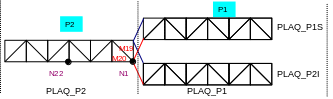
Modélisation DKT:
Nombre de nœuds |
\(26\) |
|||
Nombre de mailles |
\(39\) |
Soit: |
SEG2 |
\(3\) |
TRIA3 |
\(36\) |
Groupe de nœuds:
\(A,B,C,D,E,F,G,H\)
Groupe de mailles:
\(\mathrm{PLAQUE}\) : surface \(\mathrm{ACDF}\)
\(\mathrm{PLAQ}\text{\_}\mathrm{P1}\) : surface \(\mathrm{BCDE}\)
\(\mathrm{PLAQ}\text{\_}\mathrm{P2}\) : surface \(\mathrm{ABEF}\)
\(\mathrm{CD}\) : segment \(\mathrm{CD}\)
\(\mathrm{FA}\) : segment \(\mathrm{FA}\)
\(\mathrm{BE}\) : segment \(\mathrm{BE}\)
Résultat de la modélisation A#
Point |
Maille |
nœud |
Composante |
Référence |
Tolérance \((\text{\%})\) |
\(B\) |
\(\mathrm{N1}\) |
\(\mathrm{DZ}\) |
\(0.3515625m\) |
\(1.\) |
|
\(\mathrm{N1}\) |
\(\mathrm{DRZ}\) |
\(0.\) |
\(0.1\) |
||
\(\mathrm{M19}\) |
\(\mathrm{N1}\) |
\(\mathrm{MXX}\) |
\(-500000.\mathrm{m.N}\) |
\(3.\) |
|
\(\mathrm{M20}\) |
\(\mathrm{N1}\) |
\(\mathrm{MXX}\) |
\(-500000.\mathrm{m.N}\) |
\(5.\) |
|
\(G\) |
\(\mathrm{N22}\) |
\(\mathrm{DZ}\) |
\(-0.2629743m\) |
\(1.\) |
|
\(\mathrm{N22}\) |
\(\mathrm{DRZ}\) |
\(0.\) |
\(0.1\) |
Modélisation B#
Caractéristiques de la modélisation B#
Le maillage de la plaque est composé en deux parties :
\(\mathrm{P1}\) , constitué d’un maillage non excentré
\(\mathrm{P2}\) , constitué de deux maillages superposés :
\(\mathrm{PLAQ}\text{\_}\mathrm{P1S}\) excentré de \(\mathrm{0.015m}\)
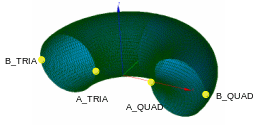
\(\mathrm{PLAQ}\text{\_}\mathrm{P1I}\) excentré de \(-\mathrm{0.035m}\)
Modélisation DKT:
Nombre de nœuds |
\(26\) |
|||
Nombre de mailles |
\(21\) |
Soit: |
SEG3 |
\(3\) |
QUAD4 |
\(18\) |
Groupe de nœuds:
\(A,B,C,D,E,F,G,H\)
Groupe de mailles:
\(\mathrm{PLAQUE}\) : surface \(\mathrm{ACDF}\)
\(\mathrm{PLAQ}\text{\_}\mathrm{P1}\) : surface \(\mathrm{BCDE}\)
\(\mathrm{PLAQ}\text{\_}\mathrm{P2}\) : surface \(\mathrm{ABEF}\)
\(\mathrm{CD}\) : segment \(\mathrm{CD}\)
\(\mathrm{FA}\) : segment \(\mathrm{FA}\)
\(\mathrm{BE}\) : segment \(\mathrm{BE}\)
On teste dans cette modélisation COEF_RIGI_DRZ négatif. Dans ce cas, le ddl DRZ a un sens physique de «drilling rotation» ou rotation autour de la normale.
Résultat de la modélisation B#
Point |
Maille |
nœud |
Composante |
Référence |
Tolérance \((\text{\%})\) |
\(B\) |
\(\mathrm{N1}\) |
\(\mathrm{DZ}\) |
\(0.3515625m\) |
\(1.\) |
|
\(\mathrm{N1}\) |
\(\mathrm{DRZ}\) |
\(0.\) |
\(0.1\) |
||
\(\mathrm{M12}\) |
\(\mathrm{N1}\) |
\(\mathrm{MXX}\) |
\(-500000.\mathrm{m.N}\) |
\(0.1\) |
|
\(G\) |
\(\mathrm{N10}\) |
\(\mathrm{DZ}\) |
\(-0.2629743m\) |
\(1.\) |
|
\(\mathrm{N10}\) |
\(\mathrm{DRZ}\) |
\(0.\) |
\(0.1\) |
||
\(\mathrm{M10}\) |
\(\mathrm{N10}\) |
\(\mathrm{MXX}\) |
\(-250000.\mathrm{m.N}\) |
\(0.1\) |
Modélisation C#
Caractéristiques de la modélisation C#
Le maillage de la plaque est composé en deux parties :
\(\mathrm{P1}\) , constitué d’un maillage non excentré
\(\mathrm{P2}\) , constitué de deux maillages superposés :
\(\mathrm{PLAQ}\text{\_}\mathrm{P1S}\) excentré de \(\mathrm{0.015m}\)
\(\mathrm{PLAQ}\text{\_}\mathrm{P1I}\) excentré de \(-\mathrm{0.035m}\)
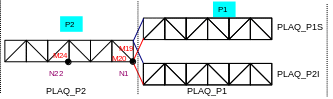
Modélisation DST:
Nombre de nœuds |
\(26\) |
|||
Nombre de mailles |
\(39\) |
Soit: |
SEG3 |
\(3\) |
TRIA3 |
\(36\) |
Groupe de nœuds:
\(A,B,C,D,E,F,G,H\)
Groupe de mailles:
\(\mathrm{PLAQUE}\) : surface \(\mathrm{ACDF}\)
\(\mathrm{PLAQ}\text{\_}\mathrm{P1}\) : surface \(\mathrm{BCDE}\)
\(\mathrm{PLAQ}\text{\_}\mathrm{P2}\) : surface \(\mathrm{ABEF}\)
\(\mathrm{CD}\) : segment \(\mathrm{CD}\)
\(\mathrm{FA}\) : segment \(\mathrm{FA}\)
\(\mathrm{BE}\) : segment \(\mathrm{BE}\)
Résultat de la modélisation C#
Point |
Maille |
nœud |
Composante |
Référence |
Tolérance \((\text{\%})\) |
\(B\) |
\(\mathrm{N1}\) |
\(\mathrm{DZ}\) |
\(0.3515625m\) |
\(0.5\) |
|
\(\mathrm{N1}\) |
\(\mathrm{DRZ}\) |
\(0.\) |
\(0.1\) |
||
\(\mathrm{M19}\) |
\(\mathrm{N1}\) |
\(\mathrm{MXX}\) |
\(-500000.\mathrm{m.N}\) |
\(2.\) |
|
\(G\) |
\(\mathrm{N22}\) |
\(\mathrm{DZ}\) |
\(-0.2629743m\) |
\(0.5\) |
|
\(\mathrm{N22}\) |
\(\mathrm{DRZ}\) |
\(0.\) |
\(0.1\) |
||
\(\mathrm{M22}\) |
\(\mathrm{N22}\) |
\(\mathrm{MXX}\) |
\(-250000.\mathrm{m.N}\) |
\(13.\) |
Modélisation D#
Caractéristiques de la modélisation D#
Le maillage de la plaque est composé en deux parties :
\(\mathrm{P1}\) , constitué d’un maillage non excentré
\(\mathrm{P2}\) , constituée de deux maillages superposés :
\(\mathrm{PLAQ}\text{\_}\mathrm{P1S}\) excentré de \(\mathrm{0.015m}\)
\(\mathrm{PLAQ}\text{\_}\mathrm{P1I}\) excentré de \(-\mathrm{0.035m}\)
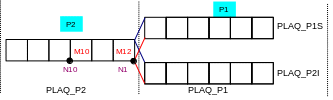
Modélisation DST :
Nombre de nœuds |
\(26\) |
|||
Nombre de mailles |
\(21\) |
Soit: |
SEG3 |
\(3\) |
QUAD4 |
\(18\) |
Groupe de nœuds:
\(A,B,C,D,E,F,G,H\)
Groupe de mailles:
\(\mathrm{PLAQUE}\) : surface \(\mathrm{ACDF}\)
\(\mathrm{PLAQ}\text{\_}\mathrm{P1}\) : surface \(\mathrm{BCDE}\)
\(\mathrm{PLAQ}\text{\_}\mathrm{P2}\) : surface \(\mathrm{ABEF}\)
\(\mathrm{CD}\) : segment \(\mathrm{CD}\)
\(\mathrm{FA}\) : segment \(\mathrm{FA}\)
\(\mathrm{BE}\) : segment \(\mathrm{BE}\)
Résultat de la modélisation D#
Point |
Maille |
nœud |
Composante |
Référence |
Tolérance \((\text{\%})\) |
\(B\) |
\(\mathrm{N1}\) |
\(\mathrm{DZ}\) |
\(0.3515625m\) |
\(0.4\) |
|
\(\mathrm{N1}\) |
\(\mathrm{DRZ}\) |
\(0.\) |
\(0.1\) |
||
\(\mathrm{M12}\) |
\(\mathrm{N1}\) |
\(\mathrm{MXX}\) |
\(-500000.\mathrm{m.N}\) |
\(0.1\) |
|
\(G\) |
\(\mathrm{N10}\) |
\(\mathrm{DZ}\) |
\(-0.2629743m\) |
\(0.4\) |
|
\(\mathrm{N10}\) |
\(\mathrm{DRZ}\) |
\(0.\) |
\(0.1\) |
||
\(\mathrm{M10}\) |
\(\mathrm{N10}\) |
\(\mathrm{MXX}\) |
\(-250000.\mathrm{m.N}\) |
\(0.1\) |
Synthèse des résultats#
Les résultats obtenus sont satisfaisants.