

v6.03.002 SSNP02 - Élément de plaque en déformations planes et traction biaxiale (loi de Norton)#
Résumé:
Ce cas-test permet de tester la loi de NORTON en utilisant la relation de comportement de LEMAITRE dans le cas d’une plaque en déformations planes en traction biaxiale. On s’intéresse aux déformations plastiques.
Solution de référence#
Méthode de calcul utilisée pour la solution de référence#
La solution de référence a été obtenue avec différents codes calculs éléments finis utilisant différents algorithmes explicites, semi-implicites ou implicites [bib2].
Grandeurs de référence#
\(\mathrm{EPXX}\) : déformation plastique suivant \(X\)
\(\mathrm{EPYY}\) : déformation plastique suivant \(Y\)
Grandeur et résultat de référence#
Instant \((s)\) |
Composante |
Référence |
30 |
\(\mathrm{EPXX}\) |
\(6.125\times {10}^{-7}\) |
\(\mathrm{EPYY}\) |
\(-4.684\times {10}^{-7}\) |
|
3630 |
\(\mathrm{EPXX}\) |
\(7.056\times {10}^{-4}\) |
\(\mathrm{EPYY}\) |
\(-5.720\times {10}^{-4}\) |
|
3660 |
\(\mathrm{EPXX}\) |
\(7.061\times {10}^{-4}\) |
\(\mathrm{EPYY}\) |
\(-5.724\times {10}^{-4}\) |
|
7260 |
\(\mathrm{EPXX}\) |
\(7.061\times {10}^{-4}\) |
\(\mathrm{EPYY}\) |
\(-5.724\times {10}^{-4}\) |
|
7320 |
\(\mathrm{EPXX}\) |
\(-2.443\times {10}^{-5}\) |
\(\mathrm{EPYY}\) |
\(1.377\times {10}^{-4}\) |
|
7350 |
\(\mathrm{EPXX}\) |
\(-7.788\times {10}^{-4}\) |
\(\mathrm{EPYY}\) |
\(8.423\times {10}^{-4}\) |
|
11010 |
\(\mathrm{EPXX}\) |
\(-1.534\times {10}^{-3}\) |
\(\mathrm{EPYY}\) |
\(1.432\times {10}^{-3}\) |
Références bibliographiques#
[bib1] Guide de Validation des Progiciels de Calculs des Structures: SFM, AFNOR technique, ISBN:2-12-486611-7
Validation de codes de calculs en viscoplasticité: Rapport d’un groupe d’intérêt scientifique .(GIS), ONERA France, 1989
Modélisation A#
Caractéristiques de la modélisation A#
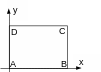
Modélisation D_PLAN:
Nombre de nœuds |
\(4\) |
|||
Nombre de mailles |
\(4\) |
Soit: |
||
SEG2 |
\(2\) |
|||
TRIA3 |
\(2\) |
Groupe de mailles:
\(\mathrm{DROITE}\) : segment \(\mathrm{BC}\)
\(\mathrm{HAUT}\) : segment \(\mathrm{CD}\)
Grandeurs testées et résultats#
Maille |
Point |
Instant \((s)\) |
Composante |
Référence |
Tolérance (%) |
\(\mathrm{MA1}\) |
\(1\) |
30 |
\(\mathrm{EPXX}\) |
\(6.125\times {10}^{-7}\) |
\(0.2\) |
\(\mathrm{EPYY}\) |
\(-4.684\times {10}^{-7}\) |
\(0.2\) |
|||
\(\mathrm{MA1}\) |
\(1\) |
3630 |
\(\mathrm{EPXX}\) |
\(7.056\times {10}^{-4}\) |
\(0.2\) |
\(\mathrm{EPYY}\) |
\(-5.720\times {10}^{-4}\) |
\(0.2\) |
|||
\(\mathrm{MA1}\) |
\(1\) |
3660 |
\(\mathrm{EPXX}\) |
\(7.061\times {10}^{-4}\) |
\(0.2\) |
\(\mathrm{EPYY}\) |
\(-5.724\times {10}^{-4}\) |
\(0.2\) |
|||
\(\mathrm{MA1}\) |
\(1\) |
7260 |
\(\mathrm{EPXX}\) |
\(7.061\times {10}^{-4}\) |
\(0.2\) |
\(\mathrm{EPYY}\) |
\(-5.724\times {10}^{-4}\) |
\(0.2\) |
|||
\(\mathrm{MA1}\) |
\(1\) |
7320 |
\(\mathrm{EPXX}\) |
\(-2.443\times {10}^{-5}\) |
\(0.2\) |
\(\mathit{EPYY}\) |
\(1.377\times {10}^{-4}\) |
\(0.2\) |
|||
\(\mathit{MA1}\) |
\(1\) |
7350 |
\(\mathit{EPXX}\) |
\(-7.788\times {10}^{-4}\) |
\(0.2\) |
\(\mathit{EPYY}\) |
\(8.423\times {10}^{-4}\) |
\(0.2\) |
|||
\(\mathit{MA1}\) |
\(1\) |
11010 |
\(\mathit{EPXX}\) |
\(-1.534\times {10}^{-3}\) |
\(0.2\) |
\(\mathit{EPYY}\) |
\(1.432\times {10}^{-3}\) |
\(0.2\) |
Modélisation B#
Caractéristiques de la modélisation B#
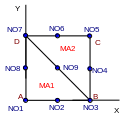
Modélisation D_PLAN:
Nombre de nœuds |
\(9\) |
|||
Nombre de mailles |
\(4\) |
Soit: |
||
SEG3 |
\(2\) |
|||
TRIA6 |
\(2\) |
Groupe de mailles:
\(\mathrm{DROITE}\) : segment \(\mathrm{BC}\)
\(\mathrm{HAUT}\) : segment \(\mathrm{CD}\)
Grandeurs testées et résultats#
Maille |
Point |
Instant \((s)\) |
Composante |
Référence |
Tolérance (%) |
\(\mathrm{MA1}\) |
\(1\) |
30 |
\(\mathrm{EPXX}\) |
\(6.125\times {10}^{-7}\) |
\(0.2\) |
\(\mathrm{EPYY}\) |
\(-4.684\times {10}^{-7}\) |
\(0.2\) |
|||
\(\mathrm{MA1}\) |
\(1\) |
3630 |
\(\mathrm{EPXX}\) |
\(7.056\times {10}^{-4}\) |
\(0.2\) |
\(\mathrm{EPYY}\) |
\(-5.720\times {10}^{-4}\) |
\(0.2\) |
|||
\(\mathrm{MA1}\) |
\(1\) |
3660 |
\(\mathrm{EPXX}\) |
\(7.061\times {10}^{-4}\) |
\(0.2\) |
\(\mathrm{EPYY}\) |
\(-5.724\times {10}^{-4}\) |
\(0.2\) |
|||
\(\mathrm{MA1}\) |
\(1\) |
7260 |
\(\mathrm{EPXX}\) |
\(7.061\times {10}^{-4}\) |
\(0.2\) |
\(\mathrm{EPYY}\) |
\(-5.724\times {10}^{-4}\) |
\(0.2\) |
|||
\(\mathrm{MA1}\) |
\(1\) |
7320 |
\(\mathrm{EPXX}\) |
\(-2.443\times {10}^{-5}\) |
\(0.2\) |
\(\mathrm{EPYY}\) |
\(1.377\times {10}^{-4}\) |
\(0.2\) |
|||
\(\mathrm{MA1}\) |
\(1\) |
7350 |
\(\mathrm{EPXX}\) |
\(-7.788\times {10}^{-4}\) |
\(0.2\) |
\(\mathrm{EPYY}\) |
\(8.423\times {10}^{-4}\) |
\(0.2\) |
|||
\(\mathrm{MA1}\) |
\(1\) |
11010 |
\(\mathrm{EPXX}\) |
\(-1.534\times {10}^{-3}\) |
\(0.2\) |
\(\mathrm{EPYY}\) |
\(1.432\times {10}^{-3}\) |
\(0.2\) |
Modélisation C#
Caractéristiques de la modélisation C#
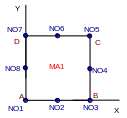
Modélisation D_PLAN:
Nombre de nœuds |
\(8\) |
|||
Nombre de mailles |
\(3\) |
Soit: |
||
SEG3 |
\(2\) |
|||
QUAD8 |
\(1\) |
Groupe de mailles:
\(\mathrm{DROITE}\) : segment \(\mathrm{BC}\)
\(\mathrm{HAUT}\) : segment \(\mathrm{CD}\)
Grandeurs testées et résultats#
Maille |
Point |
Instant \((s)\) |
Composante |
Référence |
Tolérance (%) |
\(\mathrm{MA1}\) |
\(1\) |
30 |
\(\mathrm{EPXX}\) |
\(6.125\times {10}^{-7}\) |
\(0.2\) |
\(\mathrm{EPYY}\) |
\(-4.684\times {10}^{-7}\) |
\(0.2\) |
|||
\(\mathrm{MA1}\) |
\(1\) |
3630 |
\(\mathrm{EPXX}\) |
\(7.056\times {10}^{-4}\) |
\(0.2\) |
\(\mathrm{EPYY}\) |
\(-5.720\times {10}^{-4}\) |
\(0.2\) |
|||
\(\mathrm{MA1}\) |
\(1\) |
3660 |
\(\mathrm{EPXX}\) |
\(7.061\times {10}^{-4}\) |
\(0.2\) |
\(\mathrm{EPYY}\) |
\(-5.724\times {10}^{-4}\) |
\(0.2\) |
|||
\(\mathrm{MA1}\) |
\(1\) |
7260 |
\(\mathrm{EPXX}\) |
\(7.061\times {10}^{-4}\) |
\(0.2\) |
\(\mathrm{EPYY}\) |
\(-5.724\times {10}^{-4}\) |
\(0.2\) |
|||
\(\mathrm{MA1}\) |
\(1\) |
7320 |
\(\mathrm{EPXX}\) |
\(-2.443\times {10}^{-5}\) |
\(0.2\) |
\(\mathrm{EPYY}\) |
\(1.377\times {10}^{-4}\) |
\(0.2\) |
|||
\(\mathrm{MA1}\) |
\(1\) |
7350 |
\(\mathrm{EPXX}\) |
\(-7.788\times {10}^{-4}\) |
\(0.2\) |
\(\mathrm{EPYY}\) |
\(8.423\times {10}^{-4}\) |
\(0.2\) |
|||
\(\mathrm{MA1}\) |
\(1\) |
11010 |
\(\mathrm{EPXX}\) |
\(-1.534\times {10}^{-3}\) |
\(0.2\) |
\(\mathrm{EPYY}\) |
\(1.432\times {10}^{-3}\) |
\(0.2\) |
Modélisation D#
Caractéristiques de la modélisation D#
Identique à la modélisation A. Le comportement utilisé est Norton, avec intégration implicite (NEWTON_PERT)
La solution de référence est identique à la modélisation A.
Grandeurs testées et résultats#
Maille |
Point |
Instant \((s)\) |
Composante |
Référence |
Tolérance (%) |
\(\mathrm{MA1}\) |
\(1\) |
30 |
\(\mathrm{EPXX}\) |
\(6.125\times {10}^{-7}\) |
\(0.6\) |
\(\mathrm{EPYY}\) |
\(-4.684\times {10}^{-7}\) |
\(0.6\) |
|||
\(\mathrm{MA1}\) |
\(1\) |
3630 |
\(\mathrm{EPXX}\) |
\(7.056\times {10}^{-4}\) |
\(0.2\) |
\(\mathrm{EPYY}\) |
\(-5.720\times {10}^{-4}\) |
\(0.2\) |
|||
\(\mathrm{MA1}\) |
\(1\) |
3660 |
\(\mathrm{EPXX}\) |
\(7.061\times {10}^{-4}\) |
\(0.2\) |
\(\mathrm{EPYY}\) |
\(-5.724\times {10}^{-4}\) |
\(0.2\) |
|||
\(\mathrm{MA1}\) |
\(1\) |
7260 |
\(\mathrm{EPXX}\) |
\(7.061\times {10}^{-4}\) |
\(0.2\) |
\(\mathrm{EPYY}\) |
\(-5.724\times {10}^{-4}\) |
\(2\) |
|||
\(\mathrm{MA1}\) |
\(1\) |
7320 |
\(\mathrm{EPXX}\) |
\(-2.443\times {10}^{-5}\) |
\(0.3\) |
\(\mathrm{EPYY}\) |
\(1.377\times {10}^{-4}\) |
\(0.3\) |
|||
\(\mathrm{MA1}\) |
\(1\) |
7350 |
\(\mathrm{EPXX}\) |
\(-7.788\times {10}^{-4}\) |
\(0.3\) |
\(\mathrm{EPYY}\) |
\(8.423\times {10}^{-4}\) |
\(0.3\) |
|||
\(\mathrm{MA1}\) |
\(1\) |
11010 |
\(\mathrm{EPXX}\) |
\(-1.534\times {10}^{-3}\) |
\(0.2\) |
\(\mathrm{EPYY}\) |
\(1.432\times {10}^{-3}\) |
\(0.2\) |
Modélisation E#
Caractéristiques de la modélisation E#
Identique à la modélisation A. Le comportement utilisé est Norton, avec intégration explicite (RUNGE_KUTTA)
La solution de référence est identique à la modélisation A.
Grandeurs testées et résultats#
Maille |
Point |
Instant \((s)\) |
Composante |
Référence |
Tolérance (%) |
\(\mathrm{MA1}\) |
\(1\) |
\(\mathrm{EPXX}\) |
\(6.125\times {10}^{-7}\) |
\(0.2\) |
|
\(\mathrm{EPYY}\) |
\(-4.684\times {10}^{-7}\) |
\(0.2\) |
|||
\(\mathrm{MA1}\) |
\(1\) |
3630 |
\(\mathrm{EPXX}\) |
\(7.056\times {10}^{-4}\) |
\(0.2\) |
\(\mathrm{EPYY}\) |
\(-5.720\times {10}^{-4}\) |
\(0.2\) |
|||
\(\mathrm{MA1}\) |
\(1\) |
3660 |
\(\mathrm{EPXX}\) |
\(7.061\times {10}^{-4}\) |
\(0.2\) |
\(\mathrm{EPYY}\) |
\(-5.724\times {10}^{-4}\) |
\(0.2\) |
|||
\(\mathrm{MA1}\) |
\(1\) |
7260 |
\(\mathrm{EPXX}\) |
\(7.061\times {10}^{-4}\) |
\(0.2\) |
\(\mathrm{EPYY}\) |
\(-5.724\times {10}^{-4}\) |
\(0.2\) |
|||
\(\mathrm{MA1}\) |
\(1\) |
7320 |
\(\mathrm{EPXX}\) |
\(-2.443\times {10}^{-5}\) |
\(0.2\) |
\(\mathrm{EPYY}\) |
\(1.377\times {10}^{-4}\) |
\(0.2\) |
|||
\(\mathrm{MA1}\) |
\(1\) |
7350 |
\(\mathrm{EPXX}\) |
\(-7.788\times {10}^{-4}\) |
\(0.2\) |
\(\mathrm{EPYY}\) |
\(8.423\times {10}^{-4}\) |
\(0.2\) |
|||
\(\mathrm{MA1}\) |
\(1\) |
11010 |
\(\mathrm{EPXX}\) |
\(-1.534\times {10}^{-3}\) |
\(0.2\) |
\(\mathrm{EPYY}\) |
\(1.432\times {10}^{-3}\) |
\(0.2\) |
Synthèse des résultats#
Les résultats obtenus sont satisfaisants.